Getting ready for Christmas: how that first Christmas wasn’t the beginning of the story at all!
elementor domain was triggered too early. This is usually an indicator for some code in the plugin or theme running too early. Translations should be loaded at the init action or later. Please see Debugging in WordPress for more information. (This message was added in version 6.7.0.) in /mnt/customers/customers-bh-108dcf/575c8d22-9e37-4570-b449-7bc62225f920/wp-content/wp-includes/functions.php on line 6260

Getting ready for Christmas: how that first Christmas wasn’t the beginning of the story at all!
This transcript has been automatically generated
I have been married for a little while now, and so this will be my 12th Christmas with my husband. And yet it takes me by surprise every single year just how wrong he is about Christmas. So he thinks— now wait for it— that the correct day to put up your Christmas decorations is Christmas Eve. I know, that’s the right reaction. It’s a bit shocking, isn’t it?
But by contrast, I remember this summer just passed, um, sitting in the garden of the place that we were staying at on holiday, um, and I had this little moment of sadness because our holiday was almost over. And then remembering that it was almost September and that meant the Christmas things were going to be in the shops soon, and did a little happy dance because I love Christmas and the whole build-up it, the turkey farm thing notwithstanding. But I saw an ad the other day for an online magazine called Organised Christmas. Clearly the Google algorithms have got me just right. Organised Christmas magazine sets out a 13-week plan— that’s right, a 13-week plan— to get you ready for the festive season.
But before you think, oh, that sounds helpful, what you need to know is that week 13 is actually this week, so you’ve missed it this year. Apparently, if you want to be able to relax and enjoy Christmas at all, you should have started on the 9th of September. I know, it says that you should have parboiled your potatoes and blanched your Brussels sprouts by the 19th of October, so they’re supposed to be resting merrily in the freezer ready for you to whip out and serenely cook and finish off in a relaxed manner a mere 2.5 months later on Christmas Day. Apparently, your Christmas cards were supposed to have gone in the post yesterday. And if you haven’t finished buying all your presents yet, well, you’re too late.
You’ve ruined Christmas for everyone. But if this all sounds a bit much, don’t despair, because all you need to do is subscribe to this website, and they’ll send you an email of support every single day. In the run-up to the festive season.
Well, if you thought that the writers of Organised Christmas were giving themselves plenty of time to get ready, you haven’t seen anything yet. I would love for us, just for the next few minutes, to have a look at the Christmas storey as it’s told in the Bible, in Matthew’s Gospel. So we’ve got some little gospels on the table. I’ll give you a minute to grab one of those. Sorry, you know, I need to multitask eating and having a drink and holding the gospel as well.
If you grab that and turn to page 4 with me, that would be great.
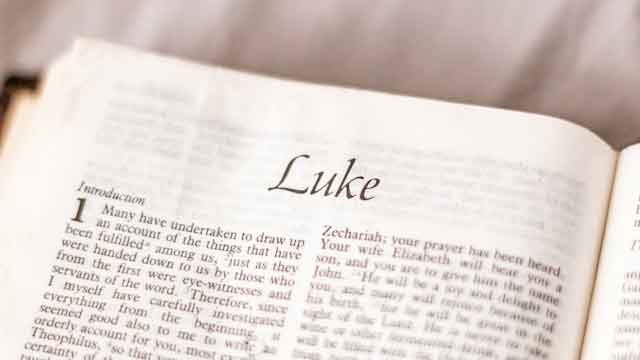
Are we all there on page 4? So Matthew, who has written this little gospel, is one of the 4 eyewitness, eyewitness accounts of what Jesus said and did that we have in our Bibles. So, I’m going to read a few verses to you. We’re just going to start at the top of page 4, at verse— little verse 18, little number 18.
Now the birth of Jesus Christ took place in this way. When his mother Mary had been betrothed to Joseph, before they came together, she was found to be with child from the Holy Spirit. And her husband Joseph, being a just man, and unwilling to put her to shame, resolved to divorce her quietly. But as he considered these things, behold, an angel of the Lord appeared to him in a dream, saying, Joseph, son of David, do not fear to take Mary as your wife, for that which is conceived in her is from the Holy Spirit. She will bear a son, and you shall call his name Jesus, for he will save his people from their sins.
All this took place to fulfil what the Lord had spoken by the prophet: Behold, the virgin shall conceive and bear a son, and they shall call his name Emmanuel, which means God with us. When Joseph woke from sleep, he did as the angel of the Lord commanded him. He took his wife but knew her not until she had given birth to a son, and he called his name Jesus.
I don’t know if you spotted this as I read that, but God himself was also very much in the business of getting ready for Christmas early. Maybe you didn’t spot that. Let’s— let me show you what I mean. If you look there at verse 22, a little 22, it says, all this— that’s the birth of Jesus— took place to fulfil what the Lord had said, had spoken through the prophet.
Now, the prophet mentioned there is a man called Isaiah, and his job, put simply, is to tell people what God had said about what’s going to happen in the future. Now, this particular prophet Isaiah was around about 700 years before Jesus was born, and Isaiah said God’s message is that in the future— we see it there in verse 23— A virgin will get pregnant, she’ll have a baby boy, and they will call him Emmanuel. Then 700 years later, we have Matthew telling us— you see it here— about a virgin called Mary who gets pregnant, who has a baby boy, and she calls his name— well, not Emmanuel, but Jesus. But I promise I’ll come back to that in a second. Now, Matthew said that that is the fulfilment of all that Isaiah had said.
That’s the working out of what he has promised.
That first Christmas was not the beginning of the storey. We see that God was getting ready for Christmas more than 700 years in advance. Now that’s an organised Christmas! But in fact, it actually gets a lot better than that, because as we read on, we see that the planning didn’t just begin 700 years beforehand, but there’s an entire backstory to why God was saying these things in the first place. And that backstory goes back hundreds and hundreds and hundreds of years, even before Isaiah was on the scene.
In fact, since the beginning of the world, actually even before that, God was getting ready for Christmas. But why? You might be wondering why. Why was that first Christmas such a big deal? That’s a good question.
So let’s see if we can have a look. So, one of the things I love most about Christmas is how excited my kids get. And so, I have 2 little ones, 8 and 4. That’s their ages, not their names, just so you understand. It’s really fun to experience some of Christmas in London through their eyes.
The lights, the music, the food. They love it, and I love getting to experience that with them. Now, I’m not saying that that’s why I had children, But if you want to draw that conclusion, I won’t argue. My husband and I really struggled to agree on names for them. Just very, very different ideas about what names we should pick.
I don’t think it’s the case so much anymore in this culture, but in many cultures, babies are given names that have meanings. You want your child to be great, so you give them a name that means something great. So, the name Alice, for example, means kind or benevolent. So you might want to choose that name in the hope that your child will be a kind child. Or Matilda means brave and fearless.
So if you want your child to grow up full of courage, you might give them the name Matilda. I checked, by the way, and after all of our deliberations, apparently my husband and I want our son to grow up to be a great stream. So that’s good. We should have checked that first. You might have noticed in this passage that we read— have a look at it again with me on page 4— that the passage mentions 2 different names for the baby that is born.
So verse 21, it says, you’re to give him the name Jesus. And then later in verse 23, they will call him Emmanuel, which means God with us. Now, it’s not just that Mary and Joseph couldn’t agree on a name. But actually, these names are hugely significant in giving us an expectation of what this baby had come to do, and therefore giving us the answer as to why God spent so long getting ready for Christmas. You’ll probably have already spotted that this baby is no ordinary baby.
His mother was a virgin. That’s not normal. Joseph doesn’t think it’s normal. This baby is not an ordinary baby. The name Jesus means God rescues or God saves.
In Joseph’s dream, he’s told to call the baby Jesus because he will save his people from their sins. Now, I wonder what comes to your mind when you hear the word sin. It often goes hand in hand with Christmas, really, doesn’t it? Marks Spencer’s apparently sells sinful chocolate cookie dough. So it’s that kind of indulgence, the, the extra spoonful of cream, the Baileys on your cornflakes.
Maybe that’s just me. It’s all a bit sinful, isn’t it? Or maybe your mind has gone to the other end of the extreme. We think murder, theft, corruption, really evil things— that is sin. But to understand exactly what God means when he says Jesus will save his people from their sins we need to see what God calls sin.
And maybe this will surprise you, maybe not, but God really cares about how we treat each other and treat his world and how we treat him. He says that we’re to love those around us and love him, and he says to not do that is sin. And Maybe that changes things, right? Suddenly, this is not just about other people. Suddenly, we need to sit up and pay attention.
Because we might all be lovely, decent people, and I’ve spoken to some of you tonight, and you’re certainly very friendly, but do you think that you could say that you’ve always lived as you would like to? You’ve never lost your temper? We’ve never been impatient, never had something bad to say about that person at work or that mum at the school gate. I certainly know that I can’t say that.
But what about loving the God who made us, loving him perfectly, not just giving him a nod at Easter and at Christmas or when we feel like it? Not one of us can say that we’ve completely met God’s standard of loving him and loving those around us completely all the time. And God really cares about that. He has promised that one day he will put an end to all of the wrong things that happen in this world, and he will hold each and every one of us to account for how we’ve lived our lives.
I, I don’t know how you feel. About me saying that. Maybe that’s not an easy thing to hear. For others, maybe you feel like I’ve hit the nail on the head. Actually, you know that you don’t even live up to your own standards, never mind God’s standards.
But either way, please keep listening because I’d love to come back to what we know about this baby from Matthew’s Gospel.
Instagram and TikTok would say that we need to try harder. That we need to be more mindful, that we need to manifest what we want to be. But Isaiah says we need someone to step in and set us on a new track. And that’s where God stepped in and saved. Look again, please, at verse 21 with me.
It says there, to call his name Jesus, because he will save his people from their sins. And that is the good news of Christmas. We all need to be rescued, but Jesus can. He can save his people from their sins. Now, there is loads more that we would want to say about how he does that and what it means to have our sins forgiven.
Do please take away these little Matthew’s Gospels and ask the friends who brought you. They would love to talk to you about this. I know that. Read in here what it says about Jesus’ life and about his death. See what God says about Jesus saving his people from their sins.
But do you remember that second name? Look at verse 23 with me. It says, they shall call his name Emmanuel, which means God with us. Now Matthew doesn’t just give us the meaning because we might not have heard that name before.
Sorry, sticky fingers. Rather, it’s the beginning of an explanation about how this little baby could ever be able to save his people from their sins. The storey of the whole Bible is a long storey of the people God made not living as they should, often in ways quite similar to the ways we fall short of that today. It’s a series of ups and downs, of highs and lows, leading to the conclusion that God needed to step in and help. And that is why Isaiah was looking forward to this great future of God with us.
And so we understand then why God himself came to help his people. There was no other way. He needed to step in and help. He came as this baby in the manger. He had to be changed and be fed and learn how to walk and learn how to talk.
And he grew up and he lived as a man, and then he died to help the people, to save his people from their sins as only God could. Now, I love Christmas. I hope that is clear. I love absolutely everything about it except the turkey. I love the glitter, which is good because I’ve got some stuck to me now that will be here until the new year.
But this is my favourite thing, and it is surely the best thing about Christmas: God himself coming to earth to save people just like you and me from our sin. Now that really is something to celebrate. It’s worth the 700-year wait. So as you prepare for Christmas this year, whether you’re ready already or you’ll be doing your present shopping on Christmas Eve, God tells us that the best and indeed the only way to be truly ready for Christmas is to come to the one he sent to save his people from their sins. So we’re going to go back to making our wreaths and our cards in a minute, but I’d love us Please, around your tables, to keep chatting about this.
Why don’t you ask the friend that you came with and what it means to them to come to Jesus? I know they would love to chat to you about it. Please take these gospels with you and maybe in a moment of peace and quiet over the Christmas season, read this wonderful explanation of the God who cares so much that he came to save his people from their sins.