The LORD is a man of war against evil, for the sake of his promise.

The LORD is a man of war against evil, for the sake of his promise.
These are the names of the sons of Israel who came to Egypt with Jacob, each with his household: 2 Reuben, Simeon, Levi, and Judah, 3 Issachar, Zebulun, and Benjamin, 4 Dan and Naphtali, Gad and Asher. 5 All the descendants of Jacob were seventy persons; Joseph was already in Egypt. 6 Then Joseph died, and all his brothers and all that generation. 7 But the people of Israel were fruitful and increased greatly; they multiplied and grew exceedingly strong, so that the land was filled with them.
8 Now there arose a new king over Egypt, who did not know Joseph. 9 And he said to his people, “Behold, the people of Israel are too many and too mighty for us. 10 Come, let us deal shrewdly with them, lest they multiply, and, if war breaks out, they join our enemies and fight against us and escape from the land.” 11 Therefore they set taskmasters over them to afflict them with heavy burdens. They built for Pharaoh store cities, Pithom and Raamses. 12 But the more they were oppressed, the more they multiplied and the more they spread abroad. And the Egyptians were in dread of the people of Israel. 13 So they ruthlessly made the people of Israel work as slaves 14 and made their lives bitter with hard service, in mortar and brick, and in all kinds of work in the field. In all their work they ruthlessly made them work as slaves.
15 Then the king of Egypt said to the Hebrew midwives, one of whom was named Shiphrah and the other Puah, 16 “When you serve as midwife to the Hebrew women and see them on the birthstool, if it is a son, you shall kill him, but if it is a daughter, she shall live.” 17 But the midwives feared God and did not do as the king of Egypt commanded them, but let the male children live. 18 So the king of Egypt called the midwives and said to them, “Why have you done this, and let the male children live?” 19 The midwives said to Pharaoh, “Because the Hebrew women are not like the Egyptian women, for they are vigorous and give birth before the midwife comes to them.” 20 So God dealt well with the midwives. And the people multiplied and grew very strong. 21 And because the midwives feared God, he gave them families. 22 Then Pharaoh commanded all his people, “Every son that is born to the Hebrews you shall cast into the Nile, but you shall let every daughter live.”
This transcript has been automatically generated
We've been thinking a little bit this year, just beginning to think about um who God is, um and begin to think about what Exodus teaches us about who God is. And I remember we said a few weeks ago that we could talk about kind of God's essence at that point, kind of, we could talk about his attributes, we could talk about his works, but instead we thought, well, maybe Exodus wants us to think about his name. And we thought about chapter 3 and how the Lord's name means that he's the utterly free God that you can't define, that doesn't need anything, but he's the Lord, the God who has chosen to bind himself to a promise, the God of Abraham and Isaac and Jacob. And remember we said that that's who we see in the face of Jesus as well, the completely free sovereign God who is so committed to his promise, that he came to be one of us. Emmanuel, God with us, the Lord Jesus.
Well, Exodus chapter 15 is an expansion of what it means to say that God is the Lord. Did you notice that in the song we just read, the word 'the Lord,' it comes up 10 times in that song? That's a lot, isn't it? It's all about the Lord. It's a riff on what it means to say that God is the Lord.
And did you see the key verse? Exodus 15:3, "The Lord is a man of war, and the Lord is a warrior. The Lord is his name." And and that's the first thing I want to say about the Lord this evening. The Lord is a warrior. And we might think that that is surprising.
Would we really want to say that the Lord is a warrior? And surely Christianity is a religion of peace, peace on earth, and that's what we believe in. But you can't get away from the fact that "the Lord is a man of war" is a pretty good summary of Exodus chapters 1 to 15. And these chapters that we've been working through this term They have been lit up by this battle between the Lord and Pharaoh. Do you remember how it began back in chapter 1 and how Pharaoh was worried that war might break out and that maybe if war broke out the Israelites might join with his enemies?
Do you remember? How stupid! What a foolish thing that Pharaoh, because he was worried that war might break out, declared war with God. An idiot! And war did break out, not with a foreign power, but with something much, much scarier than that.
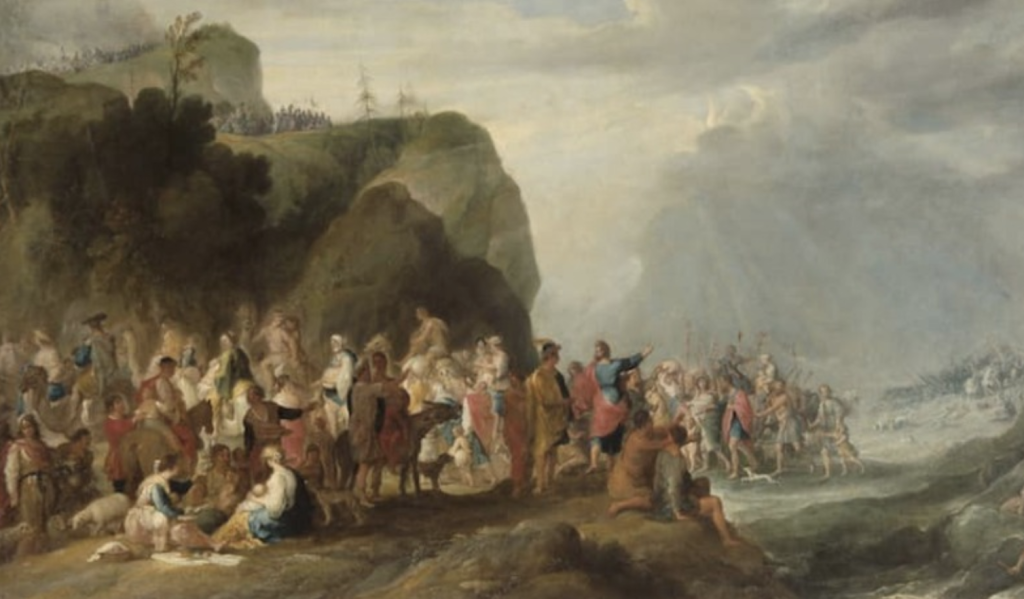
When he bent his bow, creation itself, hail and lightning, frogs, flies, gnats, darkness, locusts, death, the wind, and the waves of the sea themselves. They were his weapons. The Lord is a warrior.
What a warrior. I've just imagined that instead of fighting the Lord, Pharaoh had declared war with another empire, Assyria or Babylon or or or Rome a few hundred years later. It's hard to imagine that any other army could have defeated the Egyptians so completely. Their land was devastated, their army all dead, all of their military hardware at the bottom of the sea, their king crushed. All of it without a single Israelite raising a weapon in anger.
The Lord is a man of war. That's his name. But on its own, that's misleading because you might think that that makes God into the biggest bully in the playground, and that's not it. And secondly, the Lord is a warrior for his promise. Or you could put it the other way, the Lord is a warrior against evil.
Because that's the backstory, isn't it? Why does the Lord fight so powerfully against Pharaoh? Well, because he has deliberately set himself up against God's promise. The Lord promised life, but Pharaoh wanted death. The Lord promised blessing, but Pharaoh tried to bring a curse.
The Lord seeks freedom, but Pharaoh wanted slaves. On the one hand, Pharaoh is a great force for evil and injustice and death, and the Lord is a warrior against evil. On the other hand, he stands in the way of God's promise of new creation and blessing. And life. And the Lord is a warrior for his promise.
And here's the thing: when the Lord God, the sovereign Lord who binds himself to a promise, when he makes a promise, he commits. When the Lord sees evil and oppression, he commits. The Lord is not a distant God, who winds the world up like a wind-up toy and then leaves it to run on its own. The Lord is a campaigning God. The Lord is a warrior for his promise.
The Lord is a warrior against evil. That is his name. It's so encouraging. If the Lord overthrew through this enemy, for standing in the way of his promise, then you can be confident that he will overthrow any other enemy that stands in the way of his promise. In fact, he has, because thirdly, the Lord Jesus is a warrior.
The Lord Jesus is a warrior. And you could see this from all sorts of places, but I thought in light of the weekend, we'd just look at Ephesians. So I'm gonna read from Ephesians chapter 6, and verses 10 and 11. Actually, you could make the point from Ephesians chapter 4. And so in Ephesians chapter 4, Paul points out that because the Lord Jesus is a warrior, he has won a great victory and he has ascended on high and he's led a host of captives in his wake.
But then in chapter 6, he says this: "Finally, be strong in the Lord," that's the Lord Jesus. And here's a tip: in the New Testament, when you see the word "Lord," it's probably Jesus. Be strong in the Lord and in the strength of his might. Put on the whole armour of God, that you may be able to stand against the schemes of the devil. It's a very famous passage, all about the armour of God.
What is the armour of God? And maybe you think the armour of God is God's plan. Maybe you think the armour of God is 6 things that have some connection to each other. Maybe you think the armour of God is stuff that Paul's talked about in Ephesians so far. Actually, the armour of God, well, the key is verse 10: "Finally, be strong in the Lord and the strength of his might." It is the Lord, the Lord Jesus.
It is because Jesus rode out wearing the breastplate of righteousness, and with the helmet of salvation on his head. It's because of Jesus that there is armour for you and for me to wear. When Paul says, "Put on the full armour of God," he is saying, "Make your armour the Lord Jesus himself. Jesus the Lord, who conquered through his death and resurrection." If you make him your armour, then there is nothing- not demons, not authorities, not Egyptian kings or Roman oppressors, not Satan himself- there is nothing that can stand against you because the Lord Jesus has already conquered them all. Through his death and resurrection.
The Lord Jesus is a man of war for the sake of his promise against all evil. The Lord Jesus is a man of war. The Lord is his name. Why don't we pray? Father, we thank you so much for this amazing truth that you, the Lord, are a warrior for the sake of your promise and against evil.
We thank you so much that you don't stand far off, um letting your promise get defeated or letting evil triumph in the world. But we praise you that you ride out to fight and you triumph gloriously. And we thank you so much that through your Son, the Lord Jesus, you have come and you have overthrown the grave and death and Satan and sin through his death and his resurrection. And Father, we want to praise his name, the Lord Jesus, our champion and our warrior. In Jesus' name, amen.