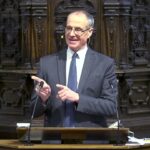
Can you spot a wolf in the City? When your life depends on it, being able to identify fraudsters is vital. In this passage, Jesus shows us how to recognise those who look genuine, but who will con us eternally.

elementor domain was triggered too early. This is usually an indicator for some code in the plugin or theme running too early. Translations should be loaded at the init action or later. Please see Debugging in WordPress for more information. (This message was added in version 6.7.0.) in /mnt/customers/customers-bh-108dcf/575c8d22-9e37-4570-b449-7bc62225f920/wp-content/wp-includes/functions.php on line 6260

Can you spot a wolf in the City? When your life depends on it, being able to identify fraudsters is vital. In this passage, Jesus shows us how to recognise those who look genuine, but who will con us eternally.
13 “Enter by the narrow gate. For the gate is wide and the way is easy that leads to destruction, and those who enter by it are many. 14 For the gate is narrow and the way is hard that leads to life, and those who find it are few.
15 “Beware of false prophets, who come to you in sheep’s clothing but inwardly are ravenous wolves. 16 You will recognize them by their fruits. Are grapes gathered from thornbushes, or figs from thistles? 17 So, every healthy tree bears good fruit, but the diseased tree bears bad fruit. 18 A healthy tree cannot bear bad fruit, nor can a diseased tree bear good fruit. 19 Every tree that does not bear good fruit is cut down and thrown into the fire. 20 Thus you will recognize them by their fruits.
21 “Not everyone who says to me, ‘Lord, Lord,’ will enter the kingdom of heaven, but the one who does the will of my Father who is in heaven. 22 On that day many will say to me, ‘Lord, Lord, did we not prophesy in your name, and cast out demons in your name, and do many mighty works in your name?’ 23 And then will I declare to them, ‘I never knew you; depart from me, you workers of lawlessness.’
This transcript has been automatically generated
The reading is taken from Matthew chapter 7, verse 13 to 23, and that can be found on page 18 of the Matthew booklets. Starting at verse 13: Enter by the narrow gate. For the gate is wide and the way is easy that leads to destruction, and those who enter by it are many. For the gate is narrow and the way is hard that leads to life, and those who find it are few. Beware of false prophets, who come to you in sheep’s clothing but inwardly are ravenous wolves.
You will recognise them by their fruits. Are grapes gathered from thorn bushes, or figs from thistles? So every healthy tree bears good fruit, but the diseased tree bears bad fruit. A healthy tree cannot bear bad fruit, nor can a diseased tree bear good fruit. Every tree that does not bear good fruit is cut down and thrown into the fire.
Thus you will recognise them by their fruits. Not everyone who says to me, Lord, Lord, will enter the kingdom of heaven, but the one who does the will of my Father who is in heaven. On that day, many will say to me, Lord, Lord, did we not prophesy in your name and cast out demons in your name and do many mighty works in your name? And then will I declare to them, I never knew you. Depart from me, you workers of lawlessness.
Well, now towards the end of the Sermon on the Mount. Just before Christmas, Tom Holland, the historian rather than the actor, tackled the historical evidence from Jesus in his well-known podcast, The Rest Is History, that he does with Dominic Sandbrook. I guess there would be plenty that you and I might want to take issue with in his 2-part piece on Jesus. But One of the aspects of Jesus of Nazareth which persuades Tom Holland that Jesus is authentic and a man of history is his teaching. Where else could such material, which in every sentence contains enduring truth that has impacted every culture in which it has landed, where else could it have come from?
No apparent lead-in, little subsequent development, The teaching of Jesus is unique in the history of humanity. It lands, you might say, like a benevolent thunderbolt from above, and it lasts. Well, Tom Hollander isn’t unique in seeing the teaching of Jesus like that. I bumped into a guy from the other side of the world on Sunday morning, and he’d just started attending one of our Sunday congregations with little apparent background in terms of connection to Jesus. What had persuaded him to start attending?
Well, he’d encountered the teaching of Jesus in the Bible. I can’t quite work out how he’d done that, but he couldn’t put it down, and it spoke for itself, and it was self-authenticating. And so he’d gone online to find a church near where he lived, and he happened to live in the Square Mile, one of the 900, and so he had found the church. I don’t know if you’ve come across F.F. Bruce and The New Testament Documents: Are They Reliable?
It was published in 1940. In its day, it was like a blast of fresh air when it landed in the middle of the 20th century. He was a professor and mounted a staunch academic and popular defence of the teaching of the New Testament. In his biography, which I hadn’t realised, when you read it, it transpires that having written the book, after a year or two, he refused to speak on the reliability of the New Testament. Why?
It defends itself. In fact, the famous preacher Charles Spurgeon defended the teaching of the Bible like this: Would you defend the teaching of Jesus? I’d rather defend a lion.
Well, we’re in the closing section of Jesus’ famous Sermon on the Mount, and here we find 2 gates, 2 trees, 2 claims, 2 buildings. 2 ways to live. And last week we looked at the 2 gates, verses 13 and 14 of today’s reading. And we saw that there are not only 2 gates but also 2 roads, one broad, the other narrow, 2 crowds, one vast, the other tiny, 2 destinations, one to life, one to destruction. And so Jesus is talking about life and death, he’s talking about eternity and destruction, And he is talking about heaven and hell.
He says there are 2 gates, 2 trees, 2 claims, 2 buildings. And this week we have the 2 trees and the 2 claims. So you see verse 15, beware of false prophets who come to you in sheep’s clothing but inwardly are ravenous wolves. And you see there in verse 21, not everybody who says to me, Lord, Lord, will enter the kingdom of heaven.
So then there are 2 trees. One is fraudulent, the other is genuine. There are 2 claims. One is false, the other is true. It seems that there are some who hold open the door that is wide.
Oh, step this way. Would you enter here? They are wolves in sheep’s clothing. It seems there are others, according to Jesus, who think they’re on the right path, but are deluded disciples.
And as such, in this enduring teaching of Jesus that people find so compelling, Jesus is actually asking us to do something which in our culture we find rather unpalatable, though actually we do it all the time in the area of business, or at least I hope you do.
He’s asking us to determine that some points of view are damaging. He’s warning us that we need to be alert, and he’s looking for us to declare an allegiance. He’s insisting that there is such a thing as rogue religion or deficient discipleship.
And when you think about it, it’s really rather strange that we find no difficulty in our corporate professional life making such distinctions, Jesus says the wolf of Wall Street is as prevalent in religious and philosophical spheres as he is on the streets of the city.
Well, let’s begin with fraudulent fruit in verses 15 through 20 before we come to counterfeit claims in 21 to 23. The fruit. Now 15 contains a straight warning, beware of false prophets who come to you in sheep’s clothing but inwardly are ravenous wolves. The language of wolf is strong and sinister. I’ve only once seen a flock of sheep put to the wolves.
Actually, it was a Great Dane and an Alsatian, and after the warriors had been dealt with, it took the rest of the afternoon with needle and thread to stitch up those of the flock that were not mortally injured. Notice that though these wolves are inwardly ravenous, Outwardly, they are dressed as members of the flock. So you might put it like this: there is no wolf stash. A sweatshirt, I am a wolf. A handbag, savage.
And there’s no warning signal, no flashing light, no loud recorded message, this sheep is a wolf.
It seems at first glance that in every way they’re genuine members of the flock. They have all the religious garb, they speak all the religious language, they have attained to all the religious titles. They may even have a PhD in theology or a chair in the faculty or a seat on the seminary board.
And notice from verse 15 that they are prophets, that is, they are teachers. And these canine imposters could be right reverends or Doctors of Divinity, or His Eminence, or Her Eminence? How to tell? Well, verses 16 and 20, you’ll see the same statement repeated. They bracket these 4 verses.
You will recognise them by their fruits, verse 16. Verse 20, thus you will recognise them by their fruits.
It’s worth recognising that we don’t tell the ravenous wolf by inward inspection. This is very important. They are inwardly ravenous wolves, but nowhere are we asked to weigh a person’s internal motive or examine their inner conviction. Look through the New Testament, you will find multiple warnings against false teachers, but we are not told to try and explore a person’s unseen desire.
In 1 Timothy 5, it’s the objective action that is examined. In 1 Corinthians 4, Paul makes it clear that the Lord alone can weigh motives. He only sees, he only knows, he only judges what’s going on on the inside. And as I say, this is important because if we were told to weigh one another’s inner motivations or the inner motivations of such and such a preacher or the other or church leader, why there would be 1,000 busybodies on the internet all speculating about things they are simply unable to know. No, we are to look at the outward fruit.
And wolves can disguise themselves as sheep and the camouflage may work for a while, but the fruit ultimately tells.
And in verses 16 through 19, we find 9 different references to fruit, Let’s read the verses. You will recognise them by their fruits. Are grapes gathered from thorn bushes or figs from thistles? So every tree, healthy tree, bears good fruit, but the diseased tree bears bad fruit. A healthy tree cannot bear bad fruit.
Now that’s reassuring, isn’t it? Nor can a diseased tree bear good fruit. Every tree that does not bear good fruit is cut down and thrown into the fire. That also is reassuring. Thus, you will recognise them by their fruits.
Now, this is interesting because in chapter 7, verse 1, Jesus warns against judging others, do not judge. But that doesn’t mean that Christians are to be naive and undiscerning sponges welcoming and soaking up whatever teaching any person brings, because the teaching the false prophet, produces fruit. And it’s just worth pausing and asking ourselves, you know, in our schools, in the companies in which we work for, in our family home, what teaching are we allowing in and absorbing undiscerningly?
Teaching always bears fruit. Whether it’s radical communism or extreme capitalism, any philosophy ultimately produces fruit.
And the New Testament is simply packed with warnings of this kind. So Luke, recording the Apostle Paul’s teaching, after my departure, fierce wolves will come in amongst you. The Apostle Paul, watch out for those who cause divisions and create obstacles contrary to the doctrine that you’ve been taught. The Apostle John, deceivers will go on ahead. The Apostle Peter, there will be false teachers among you.
Jude, the brother of Jesus, certain people have crept in unnoticed. Right the way across the New Testament then, there will be false prophets. The false prophets will arise from within, wolves in sheep’s clothing. The false prophet will be disguised. And the false prophet will do immeasurable damage to the church.
So then we have to ask the question, what is this fruit by which we will know them?
And in the immediate context of verse 15, it has initially, at least, to be their teaching. Because they are described as prophets and prophets teach.
And so, their teaching will be key. And the fruit has to be the measurable content of their instruction assessed against the objective benchmark of Jesus’ words. That they are prophets and they are described as false means there must be a true. If there’s a true, then there’s a benchmark. And so, we are being asked to consider the measurable content of this teacher’s instruction against the objective benchmark of Jesus’ Word.
And then in the context of verses 13 and 14, the false prophets are mentioned in the same breath as the narrow path and the broad road. Enter by the narrow gate, verse 13, for the gate is wide and the way is easy that leads to destruction, and those who enter by it are many. For the gate is narrow and the way is hard that leads to life, and those who find it are few.
So, do they suggest that in reality there are many paths?
Should we be concerned that in their teaching there is no mention of the hard way?
Is it that they do not speak of surrender and sacrifice and the need for reformation and repentance?
I’ve mentioned this outstanding set of printed sermons from Professor Don Carson on the Sermon on the Mount. It’s just called The Sermon on the Mount in the Biblical Classics series. Within the context of the Sermon on the Mount, the false prophet can only be someone who does not advocate the narrow way presented by Jesus. There is nothing in their preaching which fosters poverty of spirit, nothing which searches the conscience and makes men cry to God for mercy, nothing which excoriates all forms of religious hypocrisy, nothing which prompts righteousness of conduct and attitude.
I have here the most recent of a number of letters from a Church of England bishop. Listen to the language of the final paragraph.
There is a diversity of interpretation.
The Church of England has always been an intentionally and uniquely broad church. There is a breadth of views.
I haven’t received such a deceitful and deluded document for a number of weeks, full of doublespeak and the language of those who inwardly are ravenous wolves.
But there is not only the teaching. You see, the Sermon on the Mount also contains moral instruction, chapter 5, spiritual instruction, chapter 6, and relational instruction, chapter 7. And so for these teachers, we have to imagine that the fruit is the kind of fruit that comes from a teaching that says morally anything goes, no need for repentance. And for these teachers, their teaching must produce the kind of fruit that spiritually is all about ritual and rote, rather than living relationship and reformation.
And so, the fruit has to be the observable pattern of their conduct assessed against the objective benchmark of Jesus’ instruction, both their teaching and their conduct.
We need to be asking then, how does what they teach impact how they live? We need people to be close enough to those who teach us to see that they’re not actually frauds. We need to have a proper means of assessment.
A number of years ago, a guy arrived in a church just up the road from here in our local area. He was described by one member of the local clergy to me as the one who will be able to save the city clergy and the city deanery. He was utterly charming. Every time we met, it was a delight. He had a PhD in theology.
He soon became the poster boy for many of the local livery companies. They loved him. And I met one of the masters of one of the livery companies, and completely by the by, as he was explaining how much they thought this individual was so wonderful, What was it that attracted you? When we have our dinners, he always leads the way in the drinking. And he recounted how he’d stood on a chair at a private dinner downing goblets of claret whilst leading the singing.
By their fruits you will know them.
In the pastoral epistles, the Apostle Paul lays out the qualification for a genuine teacher. They are to be above reproach, The husband of one wife, with children who are believers, not open to the charge of debauchery or insubordination, not arrogant, not quick-tempered, not a drunkard, not violent, not greedy for gain, hospitable, a lover of good, self-controlled, holy, disciplined.
Now, back in the Sermon on the Mount, isn’t it interesting that Jesus is not frightened of teaching the negatives? And in reality, once again, all of us are aware of the need for the negatives. I mean, you have compliance and risk and whole departments devoted to the negatives to make sure the thing is authentic. And Jesus does not want his followers to be naive and undiscerning. We are to have our antennae operating on the alert.
There is a flock, there are charlatans. Not all spiritual banks are solvent. Not all spiritual bonds are gilt-edged. And not all spiritual brokers are to be trusted.
Does this then mean that every member of every church should be on a heresy-hunting mission? No. But we do need to warn the flock.
And if our teachers do not spell out and speak publicly the negatives of Scripture, then our children will be liberal and our grandchildren won’t be Christian at all.
Verse 19 is very reassuring. Every tree that does not bear good fruit is cut down and thrown into the fire. What a relief! Judgement will come.
Well, there are the teachers and you may be thinking, aha, well, we’ve been looking at the teachers and I can spot a number of those. Now we come to the disciples. Fraudulent fruit, counterfeit claims, 21 through 23. And I think you’ll have to agree that these are among the most challenging verses in the Bible. I’ve been reading and thinking about them for the last fortnight.
I have found myself challenged. Jesus moves from the teachers of the flock to the members of the flock. Not everybody who says to me, Lord, Lord, will enter the kingdom of heaven, but the one who does the will of my Father who is in heaven. On that day, many will say to me, Lord, Lord, did we not prophesy in your name and cast out demons in your name and do mighty works in your name? And then I will declare to them, I never knew you.
Depart from me, you workers of lawlessness.
So there is real incredulity in verse 22, isn’t there? Lord, Lord, did we not prophesy in your name? It’s possible to be seriously deluded in matters of religion.
And we can see that entering through the narrow gate is not synonymous with mere doctrinal conviction. Lord, Lord, they say. They recognise who He is, but that doesn’t necessarily bring them through the narrow gate. Even the devil recognises who Jesus is.
Nor do having Bible-teaching ministries necessarily guarantee inclusion. Did we not prophesy in your name? Nor does being engaged in spiritual warfare necessarily guarantee inclusion. Did we not cast out demons in your name? Or being engaged in mighty supernatural works, healing crusades, doing mighty works in your name.
The name of Jesus was on their lips. The power of Jesus appeared to be in their works. And yet Jesus declares, verse 23, I never knew you.
Now those have been described as heart-piercing, and they must be. And one writer puts it like this, a person may also be grievously self-deceived.
And it seems that the essential character of true discipleship is not loud profession of faith, or spectacular spiritual triumph, or great spiritual experience.
To have been a member of a vibrant youth group, that’s not enough. To have been part of the University Christian Union, signed up, that’s not it. To have had Christian parents, no, not that. To have been to a Christian school, to have been confirmed by a bishop, or baptised by an archbishop, that’s not what it’s all about. To have danced in the aisles or rolled around on the floor or signed cheques in support of great crusades.
That’s not the deal. What is the deal when it comes to authentic discipleship? What is it that assures of authenticity? The answer is in verse 21.
Not everybody who says to me, Lord, Lord, will enter the kingdom of heaven. But the one who does the will of my Father who is in heaven.
So these individuals made the mistake of confusing loud professions of faith and supernatural experience or spiritual history for true spirituality. Obedience was neglected.
And once again, we need to hold these verses in the context of the whole of the sermon or we will end in despair. Just turn back to chapter 5 and verse 2, 3, and 4.
Verse 3, blessed are the poor in spirit, for theirs is the kingdom. Blessed are those who mourn, for they shall be comforted. Blessed are the meek, for they shall inherit. Blessed are those who hunger and thirst for righteousness, for for they shall be satisfied.
And turn forward to chapter 7 and verse 13 through 14, enter through the narrow gate.
So these verses are not a threat to those who come to Jesus in surrender and determine wholeheartedly to obey his teaching.
These verses are a wake-up call to those, well, who are relying on their parents’ faith or something they did 20 or 30 years ago or just a profession with no action.
As we close, have another look at verse 23, would you? Then I will declare to them, chapter 7, verse 23, I never knew you. Depart from me. Those words are utterly chilling, but it’s not the way I think you and I would have written it.
I think the first few times I preached on this, I preached it as if, you never knew me.
And Jesus says, I never knew you.
Now the lazy preacher might then head in the direction of their kind of systematic thinking and say, oh well, it must be to do with the doctrine of election and predestination, and in the eternity of time I never knew this person.
But in the context, it’s obedience that is mentioned.
And so, it seems the genuine mark of a person who is known by Jesus lies in individual surrender, in humble service, in obedient discipleship. To be known by Jesus is to be a person who has entered through the narrow door. Is walking on the narrow way, is part of that small group who is on the road to life, a person who has actually obeyed his teaching.
So there is fraudulent fruit, there are false teachers, and there are counterfeit claims, deluded disciples. And we began with Tom Holland. And the thing that persuades him that Jesus is a figure of history is his teaching. And I suspect there are hundreds of thousands like that in the City of London. Oh yeah, they recognise his teaching.
But you see, Jesus says that’s not enough. It’s possible to have come close to the door, wonderful teaching, but never to have entered. It’s possible to have stood off and rather admired the door, never to have surrendered. It’s possible to have examined the path. I can see that path going up that mountain.
There’s a broad path over here. There are a thousand. It’s just that— it looks so good, but never actually to have set foot on it. There are 2 ways to live. And there is only one that is safe.
We are talking here on Tuesdays about heaven and hell.
We are talking here on Tuesday about life and eternity. We are talking about destruction and death. And Jesus says, the one whose teaching we admire, there is only one way. It’s the narrow way. Let’s pray.
Blessed are the poor in spirit. Lord, we acknowledge our own poverty. We come to you in humility on our knees. We confess our sin. We recognise you as Lord.
We pray, living Lord Jesus, that you would enable us to walk in the path of wholehearted discipleship, full obedience, and we ask it for your name’s sake. Amen.