This transcript has been automatically generated
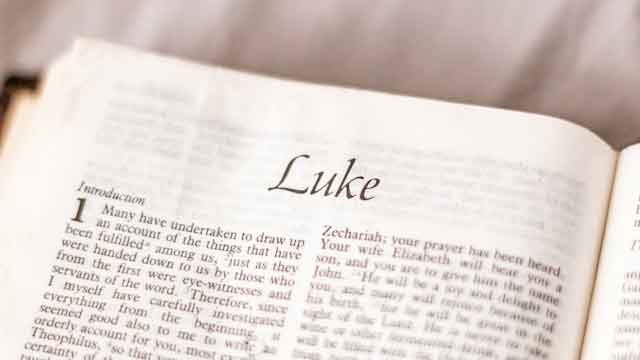
Luke chapter 4, verses 14 to 21. And Jesus returned in the power of the Spirit to Galilee, and a report about him went out through all the surrounding country. And he taught in their synagogues, being glorified by all. And he came to Nazareth, where he had been brought up, and as was his custom, he went to the synagogue on the Sabbath day, And he stood up to read. And the scroll of the prophet Isaiah was given to him.
He unrolled the scroll and found the place where it was written: The Spirit of the Lord is upon me, because he has anointed me to proclaim good news to the poor. He has sent me to proclaim liberty to the captives, and recovering of sight to the blind, to set at liberty those who are oppressed, to proclaim the year of the Lord’s favour. And he rolled up the scroll and gave it back to the attendant and sat down. And the eyes of all in the synagogue were fixed on him, and he began to say to them, Today this Scripture has been fulfilled in your hearing.
A friend of mine has a son who has quite recently really got into rowing in quite a serious way. My friend knows very little about rowing, but his son ended up in a regatta at Henley, which is like kind of headquarters of rowing. And my friend went to watch his son race. To his great surprise, he was invited to come and sit in the launch, which is the boat that follows the boats up the river. There were 3 guys in the launch, the guy steering it, I don’t know what you call that, and then there was this other guy who didn’t actually get up, so my friend didn’t get a chance to see how big he was.
And he was a nice guy, knew a lot about rowing, my friend knew very little. And so my friend started, he’s very inquisitive, and he started grilling this guy in the boat. Anyway, it was all going so well that my friend thought he would raise the question of what he and his son had been really arguing about, which was a decision at the boat race between Oxford and Cambridge by the umpire that my friend had thought had been a really bad decision. So, he raised that with the guy in the boat, and I think you can see where this is going, and the guy in the boat said, yeah, well, these things are a matter of opinion, and there are different views on it, and was thoroughly polite. Anyway, my friend got out of the boat, His telephone had gone absolutely berserk.
It was kind of buzzing with calls and so forth, and people were saying to him— anyway, he went into the marquee. When he got into the marquee, which they have at Henley, everyone’s saying, what was he like? What was he like? Anyway, it transpired that the guy in the boat was none other than Matthew Pinsent, 10 times World Championship gold medalist, 4 consecutive Olympic gold medalist, gold and the umpire of the 2025 Oxford-Cambridge race. So, anyway, to his credit, my mate is telling everybody about it.
It was very embarrassing. But mistaken identity, you know, mistaken identity can be a big thing and more than just embarrassing. And what we have as we start this new series in Luke’s Gospel that will run right the way through now till Christmas, is a new section of Luke’s Gospel. The first 4 chapters up to this point, I think I’ve called the CV, the resume of the Lord Jesus, his credentials if you like. Luke’s aim is that we have confidence and certainty concerning Jesus, who he is and why he’s come.
And right up front, Luke records for us Jesus’ appearance in the synagogue in Nazareth. And Luke wants us to see from the quote that Jesus gives, that Jesus is God’s anointed Saviour, on God’s appointed mission, with God’s authoritative Word. The anointed Saviour. Now, the scene that greets us in chapter 4, verse 14, make sure you’ve got it open, page 1036, is electric. It kind of makes, if you have them, hairs on the back of your neck stand up on end.
Verse 14, Jesus returned in the power of the Spirit to Galilee. A report about him went through all the surrounding country, and he taught in their synagogues, being glorified by all. And he came to Nazareth, where he had been brought up. And as was his custom, he went to the synagogue on the Sabbath day, and he stood up to read. And the scroll of the prophet Isaiah was given to him.
Now already Jesus is a figure of high significance and national fame. Already we have heard that the Spirit of God descended upon him on his baptism and led him into the wilderness to be tempted in chapter 4, verse 1.
But now he returns to Galilee in the power of the Spirit Report goes out far and wide. He teaches and everybody is amazed at him. And he comes to the synagogue where he grew up. This is as if Chris Martin, you know, turned up in the tiny hamlet of Whitestone near Exeter. Or Taylor Swift, you know, Pine Ridge Farm, Reading, Pennsylvania.
She sort of rocks up. Except neither of them are making self-conscious claims to divinity. Nazareth would have had a population of a few hundred, possibly a thousand. The synagogue of Nazareth would have been populated by people related to Jesus, who had been at primary school with Jesus, who had had Jesus of Nazareth in their homes fixing their kitchen cabinets and so forth as a young carpenter’s son. And now verse 17, the scroll of the prophet Isaiah was given him.
He unrolled the scroll and found the place where it was written, the Spirit of the Lord is upon me. He has anointed me to proclaim good news to the poor. Verse 20, he rolled up the scroll, gave it back to the attendant, and sat down. And the eyes of all in the synagogue And the word is, were fastened on him.
Now the Old Testament books, the books of the Old Testament in those days, well, they weren’t books, they were scrolls. There were no book bindings. The scrolls were kept in wooden racks. Possibly Joseph and Jesus had made the wooden rack in the synagogue at Nazareth, who knows? But now this local boy, Isaiah, a book of 66 chapters, you can imagine him unrolling it, finding the precise point of that.
There were no chapter numbers, no verse numbers, no page numbers. Unscrolling it, the Spirit of the Lord is upon me.
No wonder all the eyes were fastened on him. One of the ways Luke enables us to have confidence in the credibility of the Lord Jesus is through the Old Testament. I call it theological credibility.
I hope this makes sense, that Jesus does not come as a bolt from the blue. Jesus is not with, if you like, without an explanatory background. Jesus has context. And the prophet Isaiah, who was around between 750 and 700 BC, wrote both before the failure of Israel and God’s judgement on Israel, And also, as he wrote before, he spoke about a time beyond God’s judgement on the people of God, when God would act to rescue and restore.
And chapter 61 is a prophecy about the time when God would act to rescue and restore. And the Lord Jesus unscrolls the scroll, finds the precise point. The Spirit of the Lord is upon me.
Now, this on its own might begin to correct mistaken identity. I don’t know who you think Jesus is. I guess there will be people here, perhaps, who’ve never been in church before or haven’t been in church for a long time. It’s possible sometimes to get the impression that Jesus is just a kind of ordinary guy, but a bit special, but ordinary human. It’s possible for us to have too small a view of Jesus.
I think we all do, really. Jesus goes to that precise point. It’s all about me.
I mean, you know, lots of people have claimed to be the Messiah in the past. Famously, David Icke, who was goalkeeper of Birmingham City, claimed to be Messiah. Now Birmingham City needed the Messiah in goal that season, but, you know, nobody’s really taken seriously an If I was to come in this evening and say, I am the Messiah, you would say, you need a doctor. But Jesus.
But there’s more to this. I think I wanted to think for a moment about the particular sentences from Isaiah and where they find themselves. A number of famous scholars have written on the prophet Isaiah. Probably one of the, well, the leading scholar in Isaiah in the mid-20th century was a guy called Alec Motyer.
He taught a friend of ours, David Jackman, and David taught Isaiah for 20 years in the Cornhill Training Scheme just down the road. Now, towards the end of teaching Isaiah, having been taught by Alec Motyer, David wrote a book on Isaiah and he has this to say, it’s generally recognised that the final section of the book of Isaiah is centred on chapters 60 through 62.
Before and after chapters 60 through 62 of Isaiah, God promises a sovereign conqueror who is a warrior executing God’s judgement.
But in chapters 60 through 62, right at the centre point of this closing section of Isaiah, we find chapter 61, verses 1 and 2.
And here, at the centre point of the final section of the whole book of Isaiah, we hear the voice of the Lord’s Anointed describing his ministry of grace and judgement.
Now, I don’t know if you can see the kind of the majesty of what Jesus has done, in terms of just a piece of sheer theological brilliance. No chapters, no verses, no page numbers. He’s 33, he hasn’t had Alec Motyer and David Jackman and 20 years of teaching, of teaching Isaiah year after year after year. He takes hold of the scroll, unscrolls it, finds the place, the Spirit of the Lord is upon me.
And over the next 12 weeks, we’re going to be asking, well, you know, where’s the evidence?
But for now, I don’t know where you find yourself at the beginning of a new year. Every time I come face to face with Jesus in the Gospels, I say to myself, my Jesus, if you like, is too small.
He’s bigger than I ever imagined. His claims are greater than I ever thought. He’s more brilliant. I mean, just this piece of kind of theological brilliance. His divinity, His majesty, His glory.
He taught in their synagogues, being glorified by all. What a wonderful way to start a new year, and if you’re arriving in London, that Jesus is far bigger than you and I ever realised.
Then you say to yourself, well, but why has he come? If the Spirit of the Lord really is upon him, if he has been anointed to proclaim good news to the poor, what is this good news? And so, we move to the second point, Jesus is God’s anointed Saviour who is on God’s appointed mission. Now, this next piece is the most technical piece. So, if you struggle to get across London because of the Tube strike today, you know, zone in now because from the verses you can see good news to the poor, liberty to the captive, sight to the blind, liberty to those who are oppressed, the year of the Lord’s favour.
And because of the language of poor and imprisonment and oppression, this has led, and particularly over the last few decades, multiple Christian writers to suggest that Jesus has really come to alleviate financial hardship, to deal with the economic woes of the world, to help those in jail, to kind of help those oppressed in prison, wrongly imprisoned and so forth, to deal with those with physical or mental impairments, a kind of divine medical worker, social worker. In particular, this gained a lot of traction in the 1970s and 1980s in Latin America in a movement called Liberation Theology, led by a couple of guys, Leonardo Boff and Gustavo Gutiérrez, who, it won’t surprise you, were heavily influenced by Marxist and socialist philosophy. The question is, is that really what Jesus came to do? Did he really come as a glorified medic.
And it’s important we think about this, because if we think that’s what it’s actually saying, you’d end up saying, well, this manifesto that he lays out here, he doesn’t seem to have done it.
Now, because Jesus quotes from the prophet Isaiah, it is therefore important we go back to Isaiah to see what Isaiah meant when he was talking about the poor and and the blind and the oppressed?
I did the work a number of years ago and looked up every single reference to the poor and the oppressed, the marginalised and the imprisoned, and the blind in Isaiah. And here is the thing, the words used to refer to the poor in Isaiah do refer frequently to poor, oppressed, and imprisoned people, particularly in the early chapters.
But the poor and imprisoned and oppressed people to whom these words refer are the people of Israel who have been made poor as a result of their rejection of God, who had been captured by their enemies, thrown out of the Promised Land, imprisoned and oppressed, because of their rejection of God.
So, whilst they were poor, whilst they were oppressed, their poverty and oppression was caused by their rejection of the living God. It was part of his judgement on them.
And the people of Israel, the people of God, were blind, not physically, but spiritually, because they had been blinded by God in judgement. Now, I did this exercise about 20 years ago. I had someone very kind who actually colour-coded every single word that refers to the poor, or the blind, and so forth in Isaiah, with all of their references. And if you’re particularly interested, I could let you have a copy. Not afterwards, you’d have to get in touch with me and I’d let you have it.
But in my notes, when I was doing it, I wrote this: most of all, the people are afflicted as a result of their rebellion against God.
And ultimately, the affliction of the afflicted people is laid on the suffering servant of Isaiah 53, who himself is afflicted and made poor. So I would like us to turn back to Isaiah 53, if you wouldn’t mind. And you will find it on page 742. You need to realise that the word afflicted here is the same word as the word poor. There is a Very tiny, tiny difference, but it’s essentially the same word.
Chapter 53, verse 3. God is talking about a suffering servant.
Surely this servant has borne our griefs, he has carried our sorrows; yet we esteemed him stricken, smitten by God, and made poor, afflicted.
He was wounded for our transgressions, he was crushed for our iniquities, that is our sin and rebellion against God, Upon him was the chastisement that brought us peace; with his stripes we are healed. All we like sheep have gone astray; we have turned, everyone, to his own way; and God in heaven has laid on him, this suffering servant, the iniquity, the sin of us all. He was oppressed, he was afflicted, yet he did not open his mouth.
So that the affliction with which he was afflicted was in its very essence the sin and the rebellion of men and women against the living God. And God poured all of this out on his suffering servant so that God’s judgement at the sin and rebellion of his people could be removed. You can see there the link between poverty and God pouring out his judgement on his people.
Now, you may not have followed, quite followed all of that, but I think the blindness is much even clearer. When you look at blindness in Isaiah, repeatedly blindness is spiritual blindness. Just turn back a few more pages to page 690, page 690.
Page 690.
This is the commission of the prophet Isaiah. Page 690, verse 9 of chapter 6. And God said, go and say to this people, keep on hearing, don’t understand; keep on seeing, don’t perceive. Make the heart of this people dull and their ears heavy, and blind their eyes, lest they see with their eyes and hear with their ears and understand with their hearts, and turn and be healed. I said, how long?
And he said, until the cities lie waste without inhabitants, and so forth.
So that blindness in Isaiah comes as a result of God’s judgement on his people for refusing to recognise him and seeking to live life their own way in rejection of their Creator.
And so blindness in Isaiah is an inability to see the living God. It’s God’s judgement on people so that they simply cannot see, if you like, their left from their right. And you can find that again in Isaiah chapter 28, Isaiah 42, where blindness is lifted by the servant from the nations, and in Isaiah 49.
Now, having done all of that work, I was thinking maybe I’m the only person in the whole world who is thinking this way and was slightly worried as to whether I’d lost my marbles. Happened to be in Cape Town and was stuck under volcanic ash. You may not remember this, as a volcano went off and anybody who was trying to fly anywhere got stuck because you couldn’t fly because of the volcanic ash. And, you know, I spent a certain amount sitting on the beach, which was great, and then I got to feel a bit guilty. I thought I’d better do something useful, and there’s a guy in Cape Town who’d written his PhD PhD on the poor in Luke, Acts, and Isaiah and so forth.
There were only very few copies of his PhD around, and so I thought, well, I better make the use of the time, went and spent a couple of days in this, in the library in George Whitefield looking at his PhD. Here is what David Seckham has to say: there is nothing socioeconomic or socio-religious about Luke’s use of poor terminology in the passages we’ve considered. To seek to ground liberation theology or an ethic of poverty upon these texts would be to misunderstand and misuse them. Now, what is being promised in Isaiah is an anointed Messiah figure who will be a saviour to lift spiritual poverty and God’s judgement from the people of God, And to open their eyes to see God clearly and to burst open the prison cell of people held captive by an inability to see God.
In fact, I didn’t need to go all the way off to South Africa. I was talking to somebody who’s very involved in the Sunday school, leading the Sunday school, on Friday at lunch. And, oh, what are you speaking on on Sunday? I said. And she said, she said, said rather to me.
I said, well, I speak on Isaiah, I’m just looking to explain that the poor, who the poor are in Isaiah. To which she replied, oh, the poor in Isaiah are the spiritually poor, William. Well, fair enough, thanks very much. All I needed to go is some— to do was go to Sunday school. But if this is right, what we should find as we then explore these chapters is that understanding repeated through the chapters.
And that’s exactly what we’re going to find. Chapter 5, verse 8, Peter, when Jesus reveals himself to him, depart from me, for I am a sinful man. Jesus, do not be afraid.
Chapter 5, verse 24, Jesus says, the Son of Man has authority on the earth to forgive sins. Chapter 5, verse 32, I have not come to call the righteous, but sinners to repentance.
So it is spiritual poverty, it is spiritual blindness, it is the desperate condition of men and women without God that Jesus has come to deal with.
Jesus has not come first and foremost to be a glorified medic, or a glorified social worker, or a glorified prison worker. He’s come to deal with spiritual poverty. He’s come to remove the judgement of God from us. He’s come to open our eyes so that we can see God clearly.
Which again is just glorious news for us. I don’t know what kind of summer you’ve had. It’s possible at the end of the summer, and if we’ve got any sense of personal awareness, to find ourselves saying, you know, I’m far worse than I ever realised I was. I let down myself. I let down God repeatedly.
I know what I want to do, but I do the very thing I don’t want to do. And the good thing that I want to do, I find I cannot do.
And Jesus announces in that synagogue that he is both the anointed and Saviour and the appointed Saviour.
It leaves us then asking, well, how does he do this work? He is God’s anointed Saviour on God’s appointed mission. He has God’s authoritative word. Let’s look one last time at this manifesto, verses 18 through 19. And you will notice that in verse 18 there is, if you like, a headline statement and then there are 4 bullet points that are bracketed by number 1 and number 4.
The headline statement, the Spirit of the Lord is upon me. He has anointed me to proclaim good news to the poor. He has sent me to proclaim liberty to the captive, recovery of sight to the blind, to set at liberty those who are oppressed and to proclaim the year of the Lord’s favour. So how is it that Jesus is going to drive this work forward? Well, it’s there in the headline statement, through proclamation.
It’s there in bullet point number 1, and it’s there again in bullet point number 4.
And once again, as we work through this section, you will see this again and again. It is through his powerful word of proclamation, that Jesus declares his work and liberates the captive and gives sight to the blind, which of course is of acute significance for us as a church and for each one of us as an individual. It’s the time of year when lots of people are arriving in London. How is it that we’re going to be part of this saving work of the Lord Jesus? Oh, through his powerful word.
That’s how he drives his work forward. How is it that people are going to experience the forgiveness of sins? Oh, through his powerful work of proclamation. That’s how he drives his work forward. How is it that we are going to grow in our understanding of the Lord Jesus, of who he is and why he has come, and be part of his glorious work?
Oh, as we expose ourselves to his powerful work of proclamation. That’s how he drives his work forward and how we benefit from it.
I hope that explains the very heart of everything that we do here. Why do we make such a big deal of studying the Bible, as Rebecca was saying in the middle of the week? Because that’s the way God drives his work forward. It’s not primarily through kind of ritualism or rationalism or great experiences, it’s through exposing ourselves to the living Word of the Lord Jesus Christ and its proclamation. And therefore, whether we’re settling in London and looking for a church, or whether we’re going to be leaving London in just a few weeks and looking for a church in a university town or something like that, we’re going to want to find ourselves in a place where we are exposed deeply to the living word of the powerful Lord Jesus.
That’s how he drives back Satan, through his word. That’s how he declares sins forgiven, through his word. That’s how he opens the eyes of the blind, through his word. The Spirit of the Lord is upon me. He’s anointed me to proclaim good news to the poor, sent me to proclaim liberty to the captives, recovery of sight to the blind, set at liberty those who are oppressed, and to proclaim the year of the Lord’s favour.
Let me lead us in prayer.
We praise you, our Father, for the majestic Lord Jesus, your anointed Saviour of the whole world. We ask that you would open our eyes to see him more clearly.
We ask that you would give us confidence that he really is the one who forgives sins and frees us to know you, to love you, and to grow in relationship with you.
And we pray for the work of the proclamation of this glorious gospel here in St Helen’s and in every place represented by us all in this room. We ask that in your goodness this word of Jesus, this powerful word, will be spoken and spread to the benefit of all those around us. In Jesus’ name, amen.