This transcript has been automatically generated
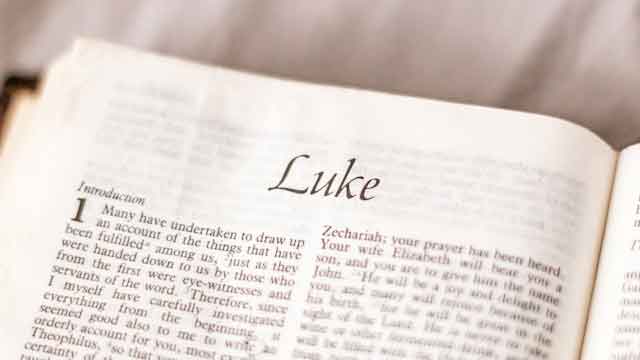
The second reading is taken from Luke chapter 19, beginning at verse 11.
As they heard these things, Jesus proceeded to tell a parable, because he was near to Jerusalem and because they supposed that the kingdom of God was to appear immediately.
He said therefore, a nobleman was went into a far country to receive for himself a kingdom and then return.
Calling 10 of his servants, he gave them 10 minas and said to them, engage in business until I come.
But his citizens hated him and sent a delegation after him, saying, we do not want this man to reign over us.
When he returned, having received the kingdom, he ordered these servants to whom he had given the money to be called to him, that he might know what they had gained by doing business. And the first came before him, saying, Lord, your mina has made 10 minas more. And he said to him, Well done, good servant; because you have been faithful in a very little, You shall have authority over 10 cities.
And the second came, saying, Lord, your mina has made 5 minas. And he said to them, And you are to be over 5 cities. Then another came, saying, Lord, here is your mina, which I kept laid away in a handkerchief; for I was afraid of you, because you are a severe man: you take what you did not deposit, and reap what you did not sow? And he said to him, I will condemn you with your own words, you wicked servant. You knew that I was a severe man, taking what I did not deposit and reaping what I did not sow.
Why then did you not put my money in the bank, and at my coming I might have collected it with interest?
And he said to those who stood by, Take the mina from him and give it to the one who has 10 minas. And they said to him, Lord, he has 10 minas. I tell you that to everyone who has, more will be given, but from the one who has not, even what he has will be taken away. But as for these enemies of mine who did not want me to reign over them, bring them here and slaughter them before me.
Well, good morning. If we’ve not met, my name is Gwilym, and I help to serve in the International Student Ministry here and also amongst the ministry trainees. Now, the question that I want us to begin with this morning is this: what are we supposed to do with the delay? And that there is a delay is one of the most significant facts about the Christian faith. We are a waiting people who have our eyes on the future.
That there is a delay is one of the most significant facts about the Christian faith, and it is also one of the most challenging. And so perhaps you’re not a Christian, um, here this morning, and if that is you, then we’re really thrilled that you have joined us. But you might think perhaps that the delay in the return of the Lord Jesus is tantamount to the non-existence of the return of the Lord Jesus. And Marxists accuse Christians of encouraging people to wait for pie in the sky when they die. And frankly, you might think it feels like that.
If the reign of the Lord Jesus Christ were a bit more visible now, if he had a city and if he had an army, peacekeeping army perhaps, if he had a kingdom, well, you might like to think that you’d be interested in joining him. It seems like he’d be a decent sort of a ruler. But this delay, it does look awfully like non-existence, reason enough perhaps to devote yourself to other things, to worry about other occupations. What are we supposed to do with the delay? Certainly, the delay has been enough for many Christians to drift and to give up on their discipleship.
And so I think of a chap that I’ll call Pete, who was in my year in the Christian Union at King’s, or Tom, who turned around a Christian group that I belonged to, or Jared, who did more than anybody else to keep me trusting the Lord Jesus when I was a teenager, or or Rupert, who was in a prayer triplet with me just a couple of years ago. And all of them were apparently keen, and all of them were leaders, and none of them are Christian now. And I can’t see into their hearts, and I don’t know what it was that led them to drift away from Jesus, but partly, I guess, they gave up waiting for a kingdom that they couldn’t see. The delay was the thing that broke them. Well, what are we supposed to do with the delay?
Even if you’re a Christian here this morning who has no intention of giving up, well, we might sometimes begin to wonder, mightn’t we? And perhaps you’re tired, I’m tired of waiting, tired of serving, perhaps discouraged because the work of the kingdom doesn’t seem to be getting anywhere. The world is going from bad to worse, the country’s going backwards. And your colleagues are going from somewhat receptive to openly hostile, perhaps shaken. The longer that you wait, the longer that goes by without visible change, the more we wonder whether we’re on a fool’s errand tilting at windmills.
What are we supposed to do with the delay? Well, we’ve been working over the last couple of months through a section of Luke that is all about the coming of the kingdom and is actually all about a delay. And we began with a question from the Pharisees about when the kingdom of God would finally come. And Jesus gave a 2-stage answer. On the one hand, he said there is going to be a future coming that’s like lightning, an explosion of light and justice and transformation that is going to change the world definitively and forever.
But on the other hand, the kingdom is already here, but not so that you can see it. In the midst of it, but hidden as tax collectors and little children and blind men and Zacchaeus in his tree come to the Lord Jesus, the Son of Man seeking and saving the lost. In other words, there is a delay. It is a 2-stage kingdom. And so what are we to do with it, and how does it affect our response?
Well, that is precisely the issue that Jesus turns again to address in the parable that we just had read for us. Why don’t you look again at chapter 19 of Luke and verse 11. And as they heard these things, Jesus proceeded to tell the crowd a parable, because he was near to Jerusalem and because they supposed that the kingdom of God was to appear immediately. He said therefore, a nobleman went into a far country to receive for himself a kingdom. And then return.
Calling 10 of his servants, he gave them 10 minas and said to them, engage in business until I come. But his citizens hated him and sent a delegation after him, saying, we don’t want this man to reign over us. And when he returned, having received the kingdom, he ordered these servants to whom he’d given the money to be called before him, that he might know what they had gained by doing business. You can see that this question, what are we to do with the delay, it is right at the heart of our passage. Verse 11, that is exactly the thing that the crowd have not understood.
Understood, Jesus wants to clarify that there will be a delay. The kingdom is not going to appear right here and right now. And the whole premise of this story, this parable, it centres on the delay. And this idea of a king going to a distant city to receive a kingdom— well, in a world governed by Rome, that would not have been hard for them to imagine. The king of Palestine travelling to a far land to receive a crown.
In fact, it had happened at least twice in the 100 years before Jesus told this parable. There’s nothing unlikely about the setup, but of course what the setup does is to introduce a delay, a gap between the moment that the next king is identified and the moment that he’s installed. A bit like the 3 months between the US elections and the inauguration of the president, or the 2 months between Warren Gatland announcing a Grand Slam and Wales delivering it. Maybe not so much like that. The whole story centres on a delay, and actually much of the parable would be the same even without a delay, wouldn’t it?
So imagine with me for a moment the parable that Jesus never told, the parable of the instant kingdom. And it would go like this, wouldn’t it? A nobleman became king. He called his 10 servants together and said to them, well done, good servants, because you have been with me before I was king, then you will have authority now over much. But some of his citizens hated him, and so he said, as for these enemies of mine who didn’t want me to reign over them, Bring them here and execute them before me.
That last line in verse 27, it sticks a little bit in the throat, doesn’t it? Because it’s stark in the description. But of course, it’s all part of the premise of the story. And this is what would happen to self-appointed enemies of the king in any self-respecting first-century kingdom. And it isn’t the point.
If Jesus had told the parable of the instant kingdom, Well, you’d still have 2 groups, enemies and servants. You’d still have 2 destinies, a reward and destruction. In fact, the whole thing would be much simpler. And there’d be those who arrive in the city with the king, who were part of his retinue, and they would be rewarded. And then there would be those who chose to reject him, and they would be rejected.
And there’d be no further complications. To the matter. And of course, that is the point of the parable that Jesus did tell, because look at verse 11 again: As they heard these things, he proceeded to tell a parable because he was near to Jerusalem and because they supposed that the kingdom of God was to appear immediately. This crowd expected to be in the king’s retinue. To be his faithful servants as Jesus the King arrived in Jerusalem to take his crown.
But a delay, a hidden kingdom and a delay, well, that introduces a complication that they are not ready for. You see, if the kingdom is manifest now, well, the response is very simple, isn’t it? You just need to choose your side. Which way do you want to go? But if there’s a delay, there is a complication.
What are you going to do in the king’s absence? What are we going to do with the delay? And Jesus tells this parable because he wants to draw out that question. And you’ll see from your handouts that we’ve got 2 points this morning. And the first is this, um, the unparalleled opportunity of the delay and the unparalleled opportunity of the delay.
I look back to verse 15. When this master returned, having received the kingdom, he ordered these servants to whom he had given the money to be called to him, that he might know what they had gained by doing business. The first came before him, saying, Lord, your mina has made 10 minas more. And he said to him, Well done, good servant! Because you have been faithful in a very little, you shall have authority over 10 cities.
And the second came saying, Lord, your mina has made 5 minas. And he said to him, and you are to be over 5 cities. In my experience, these first 2 city— the first 2 servants are the ones that we naturally tend to zoom in on. I remember more than one, um, talk from when I was a youth group member where this passage was used as a fundraising inspiration. Just as the master left his servants with 1 mina each and came back to see whether they had made anything with it, well, the youth worker would say, let’s give it a try, and give us all a pound and tell us to go away for a year and then to come back and he’d see what we’d managed to raise with it towards some worthy cause.
I have to say, and this might be very revealing, but it never really worked on me. I would do nothing for a year and then come back with £1, the pound that the youth worker had given me, plus £1 of my own pocket money, just to make sure that I didn’t look like the third servant.
It ought to go without saying— in fact, it probably does go without saying— that however effective or fun or otherwise that may be as a fundraising strategy, it has absolutely nothing to do with what Jesus is talking about here. For us, I guess it’s more likely that we might zoom in on the first 2 servants in order to sort of draw apart the difference between them. And so you have a 10-mina servant who is going to become a 10-reward servant, and you have a 5-mina servant who’s going to be a 5-city servant. And the point is that as Christians, we’re going to have different rewards when Jesus comes back in the kingdom of God. And I suppose that might be right, and certainly many great Christian thinkers have taught it, and they’ve used this parable as one of the key texts for teaching it.
But I’m not really sure that that is what this parable is getting at. I mean, to begin with, it’s a parable, and my sense is that you always need to be slightly careful about pressing the details in parables too hard. But more than that, in this parable, the first 2 servants, they belong together, don’t they? The point is not be like the 10-mina servant but not like the 5-mina servant. The point is Be like either of them, the 10 or the 5 mina servants, but don’t be like the third.
That’s the thing that he’s getting at. And the thing that both of these servants have in common, the thing that they both get right, is that they understand that the delay presents them with an unparalleled opportunity. Let me break that down. Firstly, they have the privilege of serving the man that they know will be king. I mean, regardless of the work he gives them, regardless of the outcome of their task, and regardless of whether or not he is going to reward them for it, it is a high dignity to be a trusted servant of the king-in-waiting.
People make it their ambition to belong to the royal household staff, and they probably make significant sacrifices. In order to get there. And so, just to be a servant of the man that you know will be king, well, that’s already an extraordinary opportunity, isn’t it? But more than that, there is then the privilege of the work that they are given. Verse 13, he says, engage in business until I come.
Now again, personally, I’m not sure that the main point of this parable is to explain how you serve the king, whilst he’s away. I don’t think you get the how from the parable. I think you get the how from the context, the previous chapters in Luke. But from that context, the how is really clear, isn’t it? The kingdom is here now as the Son of Man seeks and saves the lost.
As we saw last week, he is rolling back the reign of Satan as he plucks away his citizens, snatches them from his grasp, one by one. And that is a genuine kingdom work. It’s not the final overthrow of evil, but it is a genuine overthrow of evil as people come to know the true and the living God. And from the context in Luke, that is the work that these servants are entrusted with.
They know who the king is, and he is yet to start governing, but they have the opportunity to grow his assets. I mean, imagine whilst he’s away, there are many people engaged in work that the change of regime which is about to happen is going to completely sweep away. But not these 10 servants. These 10 servants are given a task that will still have meaning. It will still have value even after the king comes back.
It is a privilege. To be doing kingdom work. They’re serving the man who they know will become king. They’re engaged in a task that contributes to the future kingdom even before it’s arrived. And then there is the prospect of a lavish reward.
Verse 15 again: When he returned, having received the kingdom, he ordered these servants to whom he had given the money to be called to him, that he might know what they’d gained by doing business. The first came before him, saying, Lord, your mina has made 10 minas more. And he said to him, well done, good servant! Because you’ve been faithful in a very little, you shall have authority over 10 cities. And the second came saying, Lord, your mina has made 5 minas.
He says, I mean, you are going to be over 5 cities. Then I mentioned already that some people focus on the difference between the 2 servants, and certainly I felt beaten up by the passage in the past, um, as I’ve read it. And thought, am I a 10-mina servant or a 5-mina servant? And as I said, I’m not sure that distinction should be pressed too hard. What is transparent is that for either of these servants, the reward is out of all proportion with the work that they have accomplished.
You know, a mina is a relatively small sum of money, just 2 or 3 months of pay. And so 10 minas is hardly vast. A couple of years’ pay for an agricultural labourer. Now, if you’re a student, you might be thinking, that’s a lot of money. But when you think that these guys are effectively the Royal Investment Bank, a hedge fund for the king, it’s a pretty trivial sum.
If you were working for the Government Investment Corporation in Singapore, you wouldn’t get too excited, would you, at being entrusted with a portfolio that was the equal of 3 months of a dock worker’s wages? And yet the reward is lavish. They get to keep their return, and then they’re given 5, 10 cities to rule over. I mean, just imagine the Queen, right? Okay, the Queen, she entrusts you with £3,000 to invest.
You think, well, that’s not vast, is it? And she comes back a year later, and you are able to give her back £15,000. And you’d be— you’d have done very well, wouldn’t you? Certainly a lot better than any sort of ISA that I’ve seen recently. But still, next to her £350 million net worth, £15,000 is small change.
And then she looks at your £15,000 and says, that is absolutely marvellous. Here, keep it, and why don’t you look after Scotland for me? Or perhaps Yorkshire. It is staggeringly generous, isn’t it? And so the point is that the delay, this 2-stage kingdom, it creates an unparalleled opportunity, an opportunity to be about kingdom work before everybody else has even cottoned on to the fact that there is a kingdom coming.
The privilege of serving the master of the new heavens and the new earth the prospect of a reward that is out of all proportion with the work that we do now. And I’m conscious that we might need to hear this. It is a tired stage of year. We’re worn out from 6 months of hard work. I was going to say without the weather getting better, and then it did this morning, and now the sun’s gone back behind the clouds, so I can say it again.
It’s not unusual, is it, for grumbling to begin to take hold in March, around about now. And it’s a tired stage of life for lots of us too. Maybe the first enthusiasm of our Christian faith has been slowly ebbing away and we’re fed up of waiting, and we’re not even completely sure that the kingdom that we’re waiting for is going to happen. And if that is us, then Jesus wants us to know that the kingdom will come, that it will certainly be worth serving him in the end, and that it is the most extraordinary privilege to be able to do so now. And so I guess whatever resources we have at our disposal— time, money, gifts, expertise, or the platforms that we’ve been given— well, if we use them to do the King’s work in his absence, his work of seeking and saving the lost, even if we are used up by that task, we’re not going to be disappointed in the end.
What are we to do with the delay? Well, first of all, the delay creates an unparalleled opportunity. But actually, I think the real target of this parable is not the first 2 servants. Verse 11, as they heard these things, he proceeded to tell a parable because he was near to Jerusalem and because they supposed that the kingdom of God was to appear immediately.
Jesus told this parable for the benefit of those who were under the impression that the kingdom would appear at once. In other words, he told this parable for the benefit of those who had not been listening to him in all the things he’d been saying in the last 2 chapters of Luke. In other words, he told this parable for the benefit of those who were not ready. For the delay. And the punchline of this parable is the 3rd servant, which is our 2nd point, the unexpected danger of the delay.
Verse 20, then another came saying, Lord, here is your mina which I kept laid away in a handkerchief, for I was afraid of you because you are a severe man. You take what you did not deposit and reap what you did not sow. He said to him, I’ll condemn you with your own words, you wicked servant. You knew that I was a severe man, taking what I did not deposit and reaping what I did not sow. Why then didn’t you put my money in the bank, and at my coming I might have collected it with interest?
And he said to those who stood by, take the mina from him and give it to the one who has 10 minas. And they said to him, Lord, he’s got 10 minas. I tell you that to everyone who has, more will be given, but from the one who has not, even what he has will be taken away. The danger here is that we give this servant too much credit. And again, I have heard it that way before.
And so here is this guy who just finds the king’s work a bit difficult. Seeking and saving the lost, it’s not really his thing. Perhaps he’s a bit shy, a bit timid, maybe a little bit conservative and not gifted in lost seeking. And so he buries the mina just to make sure he doesn’t lose it because he wants to be able to bring it back when the master comes back. And then this severe master scolds him and takes away what he has and kicks him out.
And we think, yeah, this servant was a bit hard done by. Yeah, the master is way harsh. Maybe Jesus will treat me that way too. Except, of course, that that is nonsense. You need to get quite good at when people are giving excuses for their conduct, I’m not giving them too much credit.
Um, let’s imagine for a minute that the servant is right and that the master is a hard man. There is no way that the servant acted like he believed what he said. I’m sorry, verse 23, that’s what the master says, isn’t it? Why then did you not put my money in the bank? And at my coming I might have collected it with interest.
If this master really does reap what he doesn’t sow, that is extra reason to make sure that you have something to show for your investment, for his investment, something for him to reap, even if it is just the interest. And of course, he’s wrong about his master because his master is not a hard or severe man at all. He is lavishly generous. He gives rewards that are out of all proportion with the labour that has been done by his servants in his absence. Now, we shouldn’t give this 3rd servant too much credit.
What we should recognise is that he is guilty of straightforward disobedience. The master said, didn’t he, verse 13, engage in business until I come. And it’s not that this servant did business badly. It’s not that he tried to invest it and lost the principal. It is that he refused and put it into a handkerchief and buried it.
And Don Carson, in talking about the parallel passage in Matthew, he points out that the servant took the one course of action that was guaranteed not to make his master any money. It’s straightforward disobedience. It is unconscionable disobedience, isn’t it? Because regardless of whether the master comes back with a kingdom or not, let’s say the trip to Rome goes badly, he’s still this guy’s servant. He was already his master.
It is hateful disobedience because he neither knows nor loves the master. Who rewards his servant so lavishly. But supremely, supremely, and I think this is the real point, it is disbelieving disobedience. Because I think we can only conclude that this servant had decided that his master wasn’t coming back. If he loved his master and that he knew he was coming back, Well, he would have done his master’s business.
If he hated his master and he knew that his master was coming back, he would have engaged in his master’s business. The only reason I can see that you would take the mina and bury it in a handkerchief and get on with other things is because you had made the decision that you didn’t think he was coming back at all, and good riddance to him too. You see, the sting in the tail of this parable is that the same delay that creates an unparalleled opportunity also presents an unexpected danger. Imagine with me again that Jesus had told a different parable, the parable of the instant kingdom. Well, let me ask, where would this 3rd servant have been?
Would he have been one of the servants Or would he have been one of the enemies? It’s easy, isn’t it? He would have been one of the servants. He would have been in the retinue of the king, entering Jerusalem in the coronation rally, receiving the rewards. But the master’s absence, the 2-stage kingdom, it creates a new danger, a division not only between servants and enemies, but between servants and servants.
Servants who will serve the master in his absence, and those who will not. People who might like to think that if the kingdom came now, if it were obvious, that they would be right there, they’d just follow Jesus into Jerusalem. But what if they have to wait? What if the king needs to go away and then come back? Will they still be his servants then?
For at least some, In fact, I imagine the bulk of those who were listening to Jesus as he spoke this parable, the answer is no.
A 2-stage kingdom, a delay, it creates an unparalleled opportunity and also an unexpected danger. And so the question is, what are we going to do with the delay? The delay is right at the heart of this section in Luke’s Gospel. In the future, the kingdom will come in a blaze of fire, and now it is here as the Son of Man seeks and saves the lost, hidden. That was the thing that this crowd had not grasped.
That’s why they hadn’t been listening, that they didn’t realise that the kingdom wasn’t going to appear immediately. And the teaching of this parable is that the delay presents both a fresh opportunity and a fresh danger. That’s the punchline, isn’t it, in verse 26? I tell you that to everyone who has, more will be given, but from the one who has not, even what he has will be taken away. The delay is either the time to maximise your assets more and more, or it’s a time to squander it all.
And so the challenge of this parable— what will we do with the delay— is will we be ready to serve the master in his absence. Now, of course, there’s all sorts of things that we could say positively, and we’ve said some of those things already, and we’ve been concentrating on them through our meeting together this morning. Given that we have the privilege of serving the King, will we maximise his interests? Given that we understand our Master’s business, will we seek and save the lost? Given that he is so generous, bestowing his riches on all who call on him, Will we be full-blooded in working for him?
But in my judgement, this parable, it’s not mostly about how we serve. We get that from the context. Nor is it mostly about the extent of our efforts. I mean, it’s true that with such a generous master, it would be mad not to go all out for him. But in the story, we don’t know how single-minded these first 2 servants were, do we?
And they may have only given themselves to the master’s business, or they may have had other works on the side. It’s just not part of the story. We’re not told. No, this is mostly a parable about whether we will serve the king at all in his absence, or whether we’ll take the delay and his absence as a reason to give up on the kingdom altogether. And so, will you keep serving the king?
In his absence. It’s possible that there are people here that you’re not a Christian, and you might like to think that you would serve King Jesus if only it were a bit more obvious. He seems to be more competent, or at least more compassionate, than most of what passes for political leadership these days. And so if there were a united kingdom of Jesus Christ and his throne were at the centre, he had a visible capital, if he was actually present there, you’d like to think that you’d be there, or at least appreciative. But as it is, in his absence, you see no very compelling reason to be a Christian.
And Jesus told this parable for people just like you. You see, the kingdom will surely come, and in fact, it is already here in the midst of us. But if you want any part in the kingdom at all, then you need to serve the King in his absence. It’s possible that you’d call yourself a Christian because 40 years ago you signed a decision card at an evangelistic meeting and you’ve not done much about it since. And this parable was spoken for people like you, because if you want a part in the kingdom, you need to serve the King in his absence.
It’s possible that you’ve been calling yourself a Christian for years And you’re getting tired of waiting, and you’re tempted to bury your asset in the ground and focus on other pursuits. And Jesus told this parable for you. You need to understand that the delay is not a reason to lose heart or to redirect your focus or move on to other projects. It is an opportunity to serve the King. In his absence.
It is probable that for all of us, from time to time, we feel like losing heart. We’ve been Christian for so long, perhaps we’ve been waiting so long, and we begin to wonder, is it really worth serving an absentee master? What are we supposed to do with the delay? Well, it’s been a good reminder for me to look at this passage because I am here to serve the King. I’m here to serve my King.
And so because it is an unparalleled opportunity, and because there is an unexpected danger, and because the Lord Jesus is lavishly generous, and because his work is utterly worthwhile, and because the lost are there to be sought and saved, and because the reward is unimaginable, out of all proportion with anything that we might have done. What we are to do with the delay is to serve the King in his absence.
When the master returned, having received the kingdom, he ordered these servants to whom he had given the money to be called to him. That he might know what they had gained by doing business. The first came before him, saying, Lord, your mina has made 10 minas more. And he said to him, well done, good servant! Because you have been faithful in a very little, you shall have authority over 10 cities.
Shall we pray?
We thank you, our Father, that the Lord Jesus will surely return and that he will return to bring his kingdom. And we praise you too for the real privilege of being able to serve the kingdom now in his absence. We pray that you’d help us all to see the unparalleled opportunity, the privilege of being able to serve the King now. We pray that you’d give us confidence in his generosity and that we would keep going, sure that it will be worthwhile. And we pray that you’d protect any of us here from thinking that the absence of King Jesus is a reason to give up on his kingdom altogether.
We commit ourselves to your kindness in Jesus’ name. Amen.