This transcript has been automatically generatedSo the first reading you’ll find on page 708 of the Bibles. It’s Isaiah chapter 25.
O Lord, you are my God. I will exalt you, I will praise your name, for you have done wonderful things, plans formed of old, faithful and sure. For you have made the city a heap, the fortified city a ruin. The foreigners’ palace is a city no more; it will never be rebuilt. Therefore strong peoples will glorify you; cities of ruthless nations will fear you.
For you have been a stronghold to the poor, a stronghold to the needy in his distress, a shelter from the storm and a shade from the heat. For the breath of the ruthless is like a storm against a wall, like heat in a dry place. You subdue the noise of the foreigners. As heat by the shade of a cloud, So the song of the ruthless is put down.
On this mountain the Lord of hosts will make for all peoples a feast of rich food, a feast of well-aged wine, of rich food full of marrow, of aged wine well refined. And he will swallow up on this mountain the covering that is cast over all peoples, the veil that is spread over all nations. He will swallow up death forever. And the Lord will wipe away tears from all faces, and the reproach of his people he will take away from all the earth. For the Lord has spoken.
It will be said on that day, Behold, this is our God; we have waited for him that he might save us. This is the Lord; we have waited for him; let us be glad and rejoice in his salvation.
For the hand of the Lord will rest on this mountain, and Moab shall be trampled down in his place, straw is trampled down in a dunghill.
And he will spread out his hands in the midst of it, as a swimmer spreads his hands out to swim. But the Lord will lay low his pompous pride together with the skill of his hands, and the high fortifications of his walls he will bring down, lay low, and and cast to the ground, to the dust.
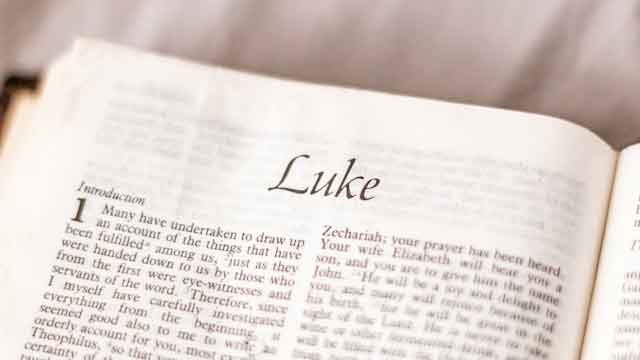
The second reading is taken from Luke’s Gospel, chapter 18, verses 1 to 8, which you can find on page 1056 of the church Bibles. Page 1056.
Luke chapter 18, beginning at verse 1.
And Jesus told them a parable to the effect that they ought always to pray and not lose heart. He said, in a certain city there was a judge who neither feared God nor respected man. And there was a widow in that city who kept coming to him and saying, give me justice against my adversary. For a while he refused, but afterwards he said to himself, though I neither fear God nor respect man. Yet because this widow keeps bothering me, I will give her justice so that she will not beat me down by her continual coming.
And the Lord said, hear what the unrighteous judge says. And will not God give justice to his elect? Who cry to him day and night? Will he delay long over them? I tell you, he will give justice to them speedily.
Nevertheless, when the Son of Man comes, will he find faith on earth? Thank you, George, very much. And again, may I add a warm welcome to you, especially— I can see a number of people who are joining us for the first time, and if that’s you, A warm welcome to you. Our subject this morning is prayer, and you can see that from sentence 1 of the reading we’ve just had, page 1056. He told them a parable to the effect that they ought always to pray and not lose heart.
And it’s there again in the last sentence, nevertheless, verse 8, when the Son of Man comes, will he find faith on earth. May I suggest that pretty much everybody prays. The anti-slave campaigner John Newton, author of some of our most famous hymns, tells of how he turned from his godless existence to following the Lord Jesus Christ in the midst of a storm, crying out in spite of himself, God help me! And then on reflection thinking, why as an atheist should he ever have cried out something like that, and that causing him to ponder and then turn to Christ. A friend of ours here, Rob Thompson, Brigadier Thompson, who has spoken here at Remembrance Day on a number of occasions over the years, says that when in Afghanistan in Helmand Province, it was a regular feature for his rough and largely not God-fearing soldiers to gather before going out on patrol and to pray.
Indeed, I spoke to his driver one day who was blown up in a personnel carrier and found himself wedged and unable to escape with at least one of the crew dead inside the vehicle. And I asked him, what did you do as you were there unable to escape? I prayed, he said. I’ve just been reading Helen Parr’s book on the Falklands, Our Boys, And it’s a fascinating and brilliant read if you’ve got the stomach for it, but you hear of these paras, hardened soldiers, in prayer. But it’s not the desperate cries of last-minute dot-com atheists that are in question this morning.
It is rather the persistent prayer of the believer. He told them a prayer to the effect that they ought always to pray and not lose heart. And the shape and the scope of the believer’s prayers are laid out for us in Luke’s Gospel in terms of the Lord’s Prayer. We’ll turn to that towards the end of our time. A prayer of personal trust in God as Father, our Father in heaven.
A prayer of humble submission to God as Lord, hallowed be your name, your kingdom come. A prayer of absolute dependence, give us today our daily bread. A prayer for God to deliver, lead us not into temptation.
But the issue this morning is not so much the content of the believer’s prayer that has already been laid out in Luke’s Gospel, but rather the practice. He told them a parable to the effect that they ought always to pray and not lose heart. And our subject is dealt with in the form of a parable And I want to dive straight into the parable itself, and then having explored the parable, to stand back and think about what it is that Jesus wishes us to learn from it. So first, God hears and will answer his people’s prayer. Let’s explore the parable.
Straight away, we need to deal with what some find a difficulty, that Jesus is making his point, as he does in other parables, by way of negative contrast with the unjust judge. Jesus is not suggesting that God is in some way unjust, uncaring, harsh, or obtuse. Quite the reverse. There are 2 figures in the parable, the widow and the judge. And from the reading, we can see that the judge is a shocker.
He neither fears God nor respects man. Verse 2. He said, in a certain city there was a judge who neither feared God nor respected man. So you could cry out to this judge, for God’s sake! And this judge would be deaf to your pleas.
You could appeal to this judge, think of your reputation! He’s not bothered. He neither fears God nor respects man. We read about figures such as this, their abuses of their position and power, in news feeds and newspapers on a regular basis. This judge thinks he is above the law.
The widow is desperate. In the first century, with no state system and a male-dominated employment culture, the widow was utterly dependent on her male relatives. And it seems that she has none. No state system, no legal aid, an unaccountable judge, no court of appeal. She has no weapon in her armoury other than her persistence, which she uses.
There was a widow in that city who kept coming to him and saying, give me justice against my adversary.
And ultimately, the judge yields. So after verse 4, a while he refused, but afterwards he said to himself, though I neither fear God nor respect man, yet because this widow keeps bothering me, I will give her justice. And then towards the end of verse 5, I will give her justice so that she will not beat me down with her demand. Literally, the text says, I will give her justice so that she will not give me a black eye with her constant approaches. But there is no evidence of violence in the text.
And so I guess the point is this: if even this loser of a judge yields ultimately, how much more will God, who loves his people, who is attentive to his people, who listens to and hears his people’s prayers, who is gracious and long-suffering towards his undeserving people, how much more will he hear and answer!
The woman is persistent because of her just cause. Her prayer is fueled by a deep conviction concerning the judge’s proper role. And her appropriate plea. The judge yields not because of a sudden change of character or even because he has a pang of conscience. He only yields to preserve his sanity, to get some peace.
And if even this unjust judge yields, how much more will God bring justice to his elect?
The point is not that we should bully God or cajole God or seek to manipulate God or threaten God or impress God or catch his attention with the extremes of our devotion. That’s pagan prayer. Remember the people who pray, the pagan prophets, the prophets of Baal who cut themselves in the books of Kings. Rather, the point is that we should be persistent in our prayers like the widow, Because God is just. He looks on his children.
He has established his judgement and his judge. And the cause for which we pray is right and pure and good and true.
Praying, Our Father in heaven, hallowed be your name, your kingdom come, is absolutely praying in line with the fundamental concerns of the God of the universe, who cares and is concerned.
And that is precisely what Jesus says in verse 7.
The Lord said, verse 6, hear what the unrighteous judge says. And will not God give justice to his elect who cry out to him day and night? Will he delay long over them? I tell you, he will give justice to them.
Speedily. He is slow to anger over them, literally, because of his long-suffering patience towards his people. He will act. We’re not sinless saints, but he is gracious towards us.
I was speaking down in Guildford yesterday at a Gospel Partnership gathering for Surrey. It was terrific. There were a number of churches there, 200 people gathered in Gospel Partnership. And I tried something I haven’t tried for many, many years. I tried a corporate question and answer session, and it worked so well, I think I’m going to see whether we can manage as effectively as the people of Surrey.
So I did tell them what the answer to every single question was before we started, just in case there was anybody— it’s like sort of GCSEs, you just tell the answers before we start and everyone will get a 9. So the answer is yes, of course we do. Okay, so here are the questions. There are 4 of them. Do you believe that God is there?
Yes, of course we do. Well, won’t you pray and not lose heart? Do you believe that God is just? Yes, of course we do. Well, won’t you pray and not lose heart?
Do you believe that God is long-suffering towards his people? Yes, of course we do. Well, won’t you pray and not lose heart? And do you believe that God has mercy on you in the gospel of our Lord Jesus Christ? Yes, of course we do.
May I say, you’ve done a lot worse than the people of Surrey who on a Saturday morning were far more enthusiastic. It looks as if we’re very uncertain about this here on a Sunday morning. Do you believe that God so loved the world that He sent His only Son? Do you believe? That God has established Jesus through His death and resurrection as Lord and Judge of the universe?
Do you believe that God is gathering His people from across the world today, even as we say our prayers? And do you believe that God will send His Son Jesus into the world on the final day, the Son of Man, to judge, to overthrow those who oppose Him, and to establish His kingly rule for eternity? Yes, that is the gospel. And so, on the basis of the character of God, the just judge, if even this crooked fraud ultimately yields, then will you not pray? Will you not pray?
God hears and will answer his people’s prayer.
But the parable comes with a question, and the question is there right at the end. I tell you, he will give justice to them speedily. Nevertheless, when the Son of Man comes, will he find faith on earth? And at this point, we need to look carefully at the context of the parable, lest we find ourselves misapplying its content. See, I can imagine somebody saying, look, I’ve been praying about my children now for years and years and years and years.
I’ve been praying about my circumstances for months and months and months and months, my boss, my health, my search for employment. My finances. I have been praying for world peace or a solution to Brexit or whatever it happens to be. Or I have been praying for the conversion of my family. And I have prayed and prayed and prayed and prayed.
The key to making proper sense of any parable is always in reading the parable properly in its context. And both the immediate context and the wider context always gives us the proper meaning. And the immediate context of this parable is really fairly straightforward. Look at verse 1, there it is. It’s bracketed, isn’t it?
He told them, the them there is his disciples. He told his disciples a parable to the effect that they ought always to pray and not to lose heart. So the aim of this parable is that we don’t give up. It’s interestingly a consistent theme in Luke’s Gospel. That he includes where the other Gospel writers do not include it.
In the parable of the sower, Luke emphasises perseverance. When he mentions Lot’s wife looking back, Luke is concerned with perseverance. This parable is unique to Luke’s Gospel. Perseverance, perseverance, perseverance. It’s a key theme, unique, frequently, in Luke’s Gospel.
So there’s the immediate context. He’s praying for his disciples that they don’t give up.
But now look at the wider context.
It’s in the wider context that we find out what it is that might cause Jesus’ disciples to lose heart and why Jesus’ disciples might give up on prayer. And why the Lord Jesus might not find faith on earth when He comes in final judgement. And the wider context is there in chapter 17, and from the beginning of the new section of Luke’s Gospel, the section begins in chapter 17, verse 11. So, verse 11 through to verse 37 give us the wider context of this parable. And the wider context of this parable is this.
If you look at verse 20, being asked by the Pharisees when the kingdom of God would come, he answered them, the kingdom of God is not coming with signs to be observed, nor will they say, look, here it is, or there. For behold, the kingdom of God is in the midst of you. And Jesus explained that the kingdom of God has arrived in the person and work of the Lord Jesus Christ, but that there will be a delay before Jesus’ final coming, and that we live, if you like, in between these times of the first coming and the final return of the Lord Jesus Christ. So the kingdom of Jesus will be unseen today.
You won’t be able to say, yeah, it’s absolutely self-evidently here amongst us. There will be a delay before he returns. Nonetheless, he has come.
And so verse 22 of chapter 17, the days are coming when you will desire to see one of the days of the Son of Man, and you will not see it. There will be a longing for one of the days of Jesus’ final coming, but we won’t actually see it. And so verse 25 of chapter 17, but first he must suffer many things and be rejected by his generation. There will be times of great rejection, great suffering, not least the rejection and suffering of the Lord Jesus, and then the rejection and suffering of his disciples as we wait for the return of Christ. And then verse 26 of verse 17 through to the end of the chapter, just as it was in the days of Noah, so will it be in the days of the Son of Man.
They were eating and drinking, marrying and being given in marriage, until the day when Noah entered the ark and the flood came and destroyed them all. Life will be going on as normal. We will be expecting the return of the Lord Jesus Christ to bring in his kingdom, but everybody around us eating, drinking, marrying, giving in marriage, oblivious to the reality that his kingdom has come and will come again.
Let’s ponder those things for just a moment. It’s not at all hard to imagine why any disciple of Jesus might long to see one of the days of the Son of Man. They’d been with Jesus and they had witnessed the kingdom of King Jesus and all of its physical reality. Where Jesus is physically, there is his kingdom in reality. They’d been with him.
They had seen the widow of Nain’s son raised to life. They had seen the calming of the storm. They had seen the healing of the demoniacs. They had, if you like, lived the life of the kingdom with the King. Not hard at all to see why they might not long to see one of the days of the Son of Man.
And not at all hard to see why we, who know the Lord Jesus Christ and are aware of what it was like when he walked the earth, might not ourselves long to see one of the days of the Son of Man.
And then verse 25, not hard to see why those who followed Jesus might long to see one of the days of the Son of Man, for he made it plain that his disciples would suffer along with him. Suffer in their families as his teaching divided son from father, mother from daughter. Suffer in their communities as they were cast out of the synagogues and brought before rulers and powers and authorities. Suffer in their workplaces and be rejected along with him by those who opposed his teaching. Not at all hard to see why one of his disciples might not long to see one of the days of his coming because of the suffering that comes to every disciple as a result of following King Jesus.
Did you read this morning about the people in the churches in the Philippines? 2 bombs in a Muslim-dominated area, going off outside the church. People in the Philippines will be longing to see.
You in your office, as you face the hostility and the opposition of those who are determined to stop people even speaking of the Lord Jesus Christ publicly, not hard to see why we might not long to see one of the days of the Son of Man.
And not at all hard to see why, from verses 26 through 37, his disciples would long to see one of the days of the Son of Man, because like Noah and like Lot, they would be living in this world as aliens and exiles and longing for the wickedness of this world to be brought to an end. Do you not open the newspapers and see the sheer wickedness and injustice of this world? Think, well, I live as an alien in a foreign land and I long for the return of King Jesus.
So the Christian disciple will be like the child at boarding school longing for the holidays. And the Christian disciple will be like the migrant worker longing for home. And the Christian disciple will be like the soldier in a foreign land longing for the declaration of peace and the troopship of back to home soil.
And so, there will always be heavenly homesickness, there will always be battle weariness, and there will always be the sense of being the odd one out.
And therefore, the point of this parable is not that we necessarily deliver a just world here and now, such that we direct all our energies into prayer towards solving the immediate problems of this world, nor is it that we will necessarily get justice today in this world as we cry out to Him day and night. And the point of this parable is not to give, if you like, a blank cheque that the believer will always get what they ask for if only they keep on and on and on and on at God. You may have come across that kind of teaching, if only I shout loud enough, to God in prayer, or pray long enough in prayer, or get the right formula, or use the right words, or do the right exercises, then I’ll twist God’s arm into answering my prayer. The point rather is, given the delay, given the suffering, and given the profound sense of dislocation that each and every one of Jesus’ disciples will find to be their experience, Knowing that in one sense the kingdom has come and yet we’re still waiting. Will we give up waiting and longing and turning to him in prayer?
Consider the character of God. Do we actually think God is unjust like this unjust judge? Of course we don’t.
Do we really believe that God is inconsistent within himself? Of course we don’t. Do we genuinely consider that God will not act on his promises? Of course we don’t. Do we conclude that having sent his Son into the world, he won’t hear and answer our prayers to return and bring justice to this earth?
Of course we don’t. Will we persist in prayer?
He told them a parable to the effect that they are always to pray and not lose heart. I tell you, he will give justice to them speedily. Nevertheless, when the Son of Man comes, will he find faith on earth? And that leaves that one word which needs attention, doesn’t it, in verse 8, speedily. I don’t think Jesus could be saying that he will answer our prayers to deliver us speedily in this world, absolutely certainly, from whatever it is we’re currently facing.
Much more likely, given the context of chapter 17 and the question of verse 8, that this is a promise of his speedy return in final judgement to bring justice to all his people worldwide. And so, will we keep trusting him and calling out to him, conscious that he will return? Ah, says somebody, This parable was told 2,000 years ago and he hasn’t come back. Do you call that speedily?
Well, flick forward if you would to 2 Peter, which you will find on page 1,226. 1,226, 2 Peter chapter 3. And verse 8.
Do not overlook this one fact, beloved, that with the Lord one day is as a thousand years, and a thousand years as one day. The Lord is not slow to fulfil his promise, as some count slowness, but is patient towards you, not wishing that any should perish, but that all should reach repentance. So to God, in terms of eternity, 2,000 years is as last Friday lunchtime is to us— 2 days.
And so we finish where we began. He told them a parable to the effect that they ought always to pray. And not lose heart. Nevertheless, when the Son of Man comes, will he find faith on earth?
Isn’t it interesting that Jesus roots our prayerfulness in our understanding of the character of God? Hear what the unrighteous judge says, and will not God give justice? Where does the Lord’s Prayer begin? With God, our Father. Father in heaven.
So, do we believe in the Christian God, a personal, loving, heavenly Father who cares? Well then, will we pray? Will we pray personally?
Isn’t it interesting that Jesus roots our prayerfulness in the awareness of the just nature of the cause? Where does the Lord’s Prayer focus first? Hallowed be your name. Your kingdom come. Do we believe that God wants his name to be honoured and his kingdom established?
Well then, will we pray?
Isn’t it interesting that Jesus roots our prayerfulness in a sense of our utter dependency? There was a widow. She had nowhere else to look.
What is the substance of our requests in the Lord’s Prayer? Give us today our daily bread. Forgive us our sins. Lead us not into temptation. The self-sufficient person will not pray, give us today our daily bread.
The self-righteous person will not pray, forgive us our sins. The self-assured person will not pray, lead us not into temptation. Will we pray?
And isn’t it interesting, finally, that the very first place Luke takes us, having told us of the delay that there will be before Jesus’ return, is to the place of personal living faith, personal trust in the living God. How we pray, what we pray, whether we pray, It tells us everything about our relationship with God as we wait for the return of Jesus Christ. Will He find faith when He comes? Will He find it? Will we pray?
So, here’s a thought for us in the next 15 minutes or so, over coffee, rather than bore one another with Brexit.
And perhaps in the next couple of hours over lunch, rather than bang on about the state of English cricket or the Australian Open or the FA Cup 4th round, might we talk to one another about this issue of prayer? How does what Jesus teaches about God stimulate us to pray? How does what Jesus teaches about God in this parable stimulate us to pray?
What are the things that cause us to lose heart in prayer?
Why, given what we know about God in the Christian gospel, ought we not lose heart in prayer?
And perhaps over coffee and over lunch, we might encourage one another. To pray.
And if you are somebody who says, well, to be honest, you know, I don’t really pray at all, I think I want to ask you, well, don’t you? I mean, have you ever listened to the soundtrack of the 9/11 catastrophe and wickednesses and how, as the towers came down, oh my God, There are very few people who don’t pray at all.
And if you find yourself thinking, well, how come it is that I, people, and I sometimes cry out to God in a moment of desperation rather like this helpless widow?
And that causes you to think like John Newton thought, well, maybe I do believe in God after all. Then the Lord’s Prayer is a great place to begin. Our Father in heaven, hallowed be your name. In fact, the moment you pray the Lord’s Prayer with understanding and mean it is the day you become a Christian. Let’s pray together.
Our Father in heaven, we thank you, our Father, that we can call you Father, that we can draw near to you in the name of Jesus Christ with our sins forgiven, knowing that you are there, that we can draw near to you with freedom and with confidence. Our Father in heaven, we do pray that your name be hallowed, That Your kingdom come. We long for Your kingdom to come, for justice to be established across the globe, for wrongs to be righted, sins punished. We long for Your kingdom to come.
We pray that You would keep us calling out to You day and night, give us today our daily bread, forgive us our sins, Lead us not into temptation. May our homes be centres of prayer. May our hearts be places of prayer as we call out to you day and night. We pray for ourselves as a church family. May we be a people of prayer.
May you find faith on the earth when you return.
In Jesus’ name. Amen.